Reflecting on the importance of Open Access publishing for researchers in Open Access Week 2026 – by Eirini Goudarouli, Anna-Maria Sichani and Jane Winters
In this series of blog posts, recent UoL Press authors share their own publishing experiences and words of advice and support for new authors, and reflect on the importance of open access publishing for researchers.
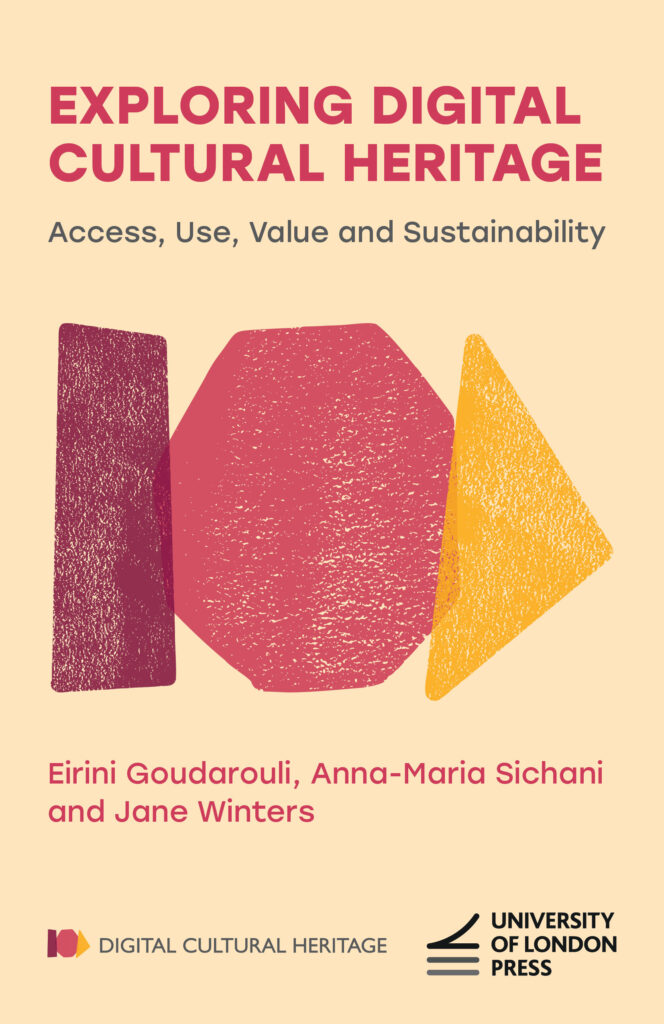
Eirini Goudarouli is the Head of Research at The National Archives, UK. Anna-Maria Sichani is a BRAID Research Fellow and a Research Associate in Digital Humanities at School of Advanced Study, University of London. Jane Winters is Professor of Digital Humanities at the School of Advanced Study, University of London, UK. They are the authors of Exploring Digital Cultural Heritage.
1. Tell us about your book with UoL Press.
JW: Exploring Digital Cultural Heritage is written as an accessible starting point for anyone interested in the past, present and future of digital cultural heritage. The digitisation of cultural heritage has had a transformative effect both on humanities research and on research and professional practice in the cultural heritage sector, even if the scale and nature of this impact is still at an early stage. As more of the world’s cultural heritage is born-digital, the questions posed by new digital archives and collections will bring complexity and new challenges, but also opportunities and commonality of method and approach across sectors. The book explores the multiple interpretations, contexts and uses of digital cultural heritage across four core thematic areas: access, use and reuse, value(s) and sustainability.
EG: I agree with Jane, Exploring Digital Cultural Heritage was conceived as an accessible entry point into the ideas, developments and questions shaping the past, present and future of digital cultural heritage. We also saw the book as an introduction to the wider series and to our ambition to create a collaborative space where professionals and researchers from across Galleries, Libraries, Archives and Museums (GLAM), alongside colleagues from academia, can come together to exchange ideas, share perspectives and engage with some of the key themes shaping the rapidly evolving Digital Cultural Heritage field. You can find more about the themes we are interested in exploring on the series webpage.
AMS: This book seeks to formally establish Digital Cultural Heritage as an interdisciplinary and cross-sectoral field of research and practice. It reflects on the field’s development over the past two and a half decades while also considering its open, challenging and promising future. Interestingly, Digital Cultural Heritage has long been developed as a rich, diverse and multifaceted field of practice and research, however, there has not yet been a single, comprehensive introductory text that brings these different dimensions together. Well, this book is doing exactly that! With its accessible style and concise format, this book can be read as an introductory textbook, a practical, evidence-based field guide and a roadmap for the future of Digital Cultural Heritage and of the series it inaugurates!
2. What advice do you have for authors looking to publish their first book?
JW: There are lots of practical things to think about, for example: Does the publisher have an existing series where your book would sit naturally? Do their books have high visibility online? Are the printed copies of their publications produced to a high standard (particularly important if you are working with images)? But I think it’s also important to consider whether the publisher’s values align with yours as an ethical researcher. University of London Press foregrounds its values as advocating for the humanities, being approachable and flexible in its collaborations with authors, championing open research and combining rigour and expertise with transparency. All of these spoke to us as editors and authors.
EG: I think the point about considering whether a publisher’s values align with your own as an ethical researcher is a really important one. Equally important is thinking carefully about the audiences you want to reach and what you hope the book will offer them. What questions might it encourage them to ask, what challenges might it help them navigate, and what new perspectives might it open up? For our book, this meant encouraging reflection on the challenges facing cultural heritage in a rapidly evolving technological landscape. More broadly, it is worth thinking about how a book can speak to readers’ sense of identity and purpose, not only as members of GLAM or academic communities, but also as members of wider society.
AMS: I wish there were a trusted guide to help researchers when embarking on the journey of publishing their manuscript into a book! You definitely need to find a publisher whose values and portfolio align with your own, who believes in your book as much as you do and who will support you with their professionalism throughout the entire publishing journey. Publishing a book is a marathon, not a sprint: from submitting your manuscript for review to navigating proofreading and production, every stage requires commitment and resilience, alongside equal measures of passion. There is also work to be done once the book is out in the world: positioning it within the right scholarly and professional contexts and reaching the audiences for whom it matters most. All this work will shape you, both as a researcher and as a professional. That is why you need to find a publisher who will guide you, support you and keep you motivated throughout the journey.
3. Was it important to you to publish your book with an open access university press?
JW: It was essential for us to publish our book with an open access university press. It’s the first volume in a new series and, as well as setting out our understandings of the field of digital cultural heritage, it is designed to communicate the aims of the series to potential authors. We want to encourage submissions from around the world and that means removing barriers to access. It’s also important for work in a developing field to be widely accessible, so that it reaches those whose research is aligned but not necessarily centrally concerned with the key topics. The serendipitous audience is much likely to find open access material.
AMS: In a rapidly changing publishing landscape, choosing to publish our book through a university press under a diamond open access model was a deliberate, carefully considered decision. It reflected both the identity of the book itself and our shared commitment to lowering barriers to knowledge in a responsible and ethical way. For a book on Digital Cultural Heritage, a field shaped by rapid technological change and urgent developments, diamond open access enables immediate dissemination and facilitates engagement across disciplinary and geographical boundaries. Clear licensing conditions (CC) also enable this book to be embedded in curricula, shared and reused in different contexts and communities, with traceable, real-world impact. Publishing with a university press deeply rooted in the Humanities and committed to open scholarship, such as the University of London Press, also situates our book, the series and, hopefully, the wider field of Digital Cultural Heritage at the heart of a values-led academic ecosystem where we feel we all naturally belong.
4. The theme of International Open Access week is ‘The Cost of Knowledge’. How do you feel diamond open access helps maximise the value and impact of scholarly knowledge for humanities researchers?
EG: Open access is crucial to the circulation of knowledge, breaking down barriers to access and enabling wider collaboration. We are therefore delighted to be working with University of London Press, whose diamond open access model supports our ambition to make the book freely accessible and its ideas available to as wide an audience as possible.
AMS: Diamond open access allows us, as authors and as readers, to affirm and celebrate the value of knowledge as a scholarly contribution, rather than worrying about cost allocation either via a book/author publishing charge (BPC/APC) or a price. This is the safer route to a fairer, equitable access to scholarly knowledge. We need to work together to explore and operationalise business models and shared community-led infrastructures that will enable us to advance this mission and turn our collective values into meaningful, lasting change.

Read, download or purchase Exploring Digital Cultural Heritage: Access, Use, Value and Sustainability
Read more about the Digital Cultural Heritage series. The series is actively inviting new book proposals.
Learn more about our Open Access policy