Statistics
Our Tableau data visualisation below allows you to explore the data we collect about our open access books. If you’d like more information on how this data is collected, see the ‘About our data’ section on this page.
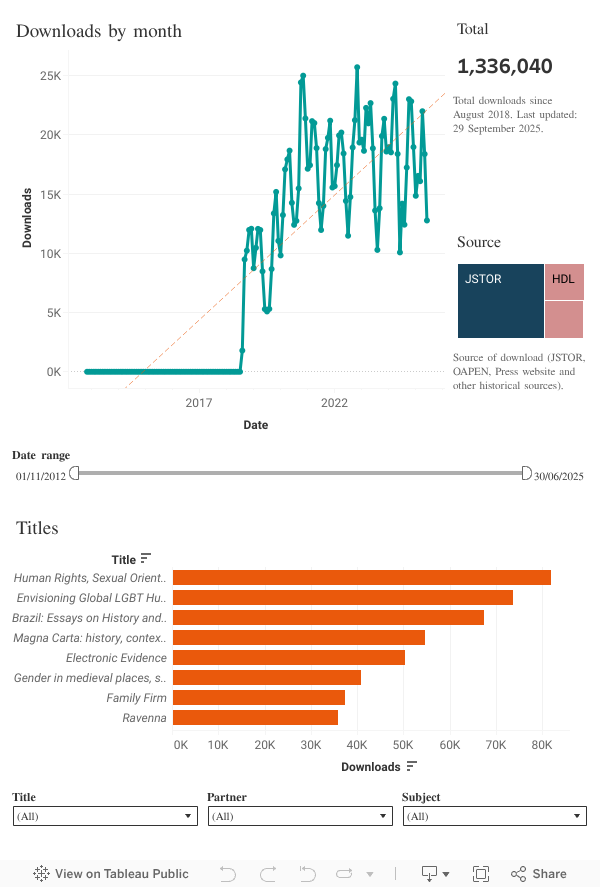
The data visualisation above can be filtered by using the institute, series and title dropdowns at the bottom of the visualisation, or directly by clicking on a particular title, source or download month. The date range can also be changed by adjusting the slider or by clicking the date at either end of the slider and entering a specific date. Please contact us at uolpress.help@sas.ac.uk if you have any questions.
About our data
UoL Press is proud to partner with a number of distribution services for our open access books. We collate engagement data from the following partners:
| Source | Measure | Description | COUNTER 5 compliant? |
| JSTOR | Item requests (views and downloads) | Data supplied via third-party | TRUE |
| OAPEN | Item requests (views and downloads) | Data supplied via third-party | TRUE |
| Website (GA4) | Item downloads | Event data tracked via Google Analytics 4 | FALSE |
Our data is updated quarterly with the latest figures provided from these partners. We currently only track item requests by title (i.e., how many views and downloads a title has received), but are exploring the possibility of tracking country data available from both JSTOR and OAPEN, with a view to including this in our reporting in the future.
Geographical data for our open access titles from JSTOR, showing in which countries they have been downloaded, is available to download from this spreadsheet. This spreadsheet is updated each quarter.
We also hope to add new distribution partners who can help us with the dissemination of our open access books over the next few years, and will expand the list above to include more data as this develops.
You may also note in the data some historical sources in the data: Humanities Digital Library (HDL – an older OA platform used by the Press) and SAS Space (SS – a repository). We no longer use these to distribute open access books, but some historical data from when they were used is still present in the visualisation.