Reflecting on the importance of open access publishing for researchers in Open Access Week 2026 – by Victorie Knox
In this series of blog posts, recent UoL Press authors share their own publishing experiences and words of advice and support for new authors, and reflect on the importance of open access publishing for researchers.
Victorie Knox is a lecturer at the University of London’s Refugee Law Initiative and has taught at postgraduate level at the School of Advanced Study, University of London since 2016.
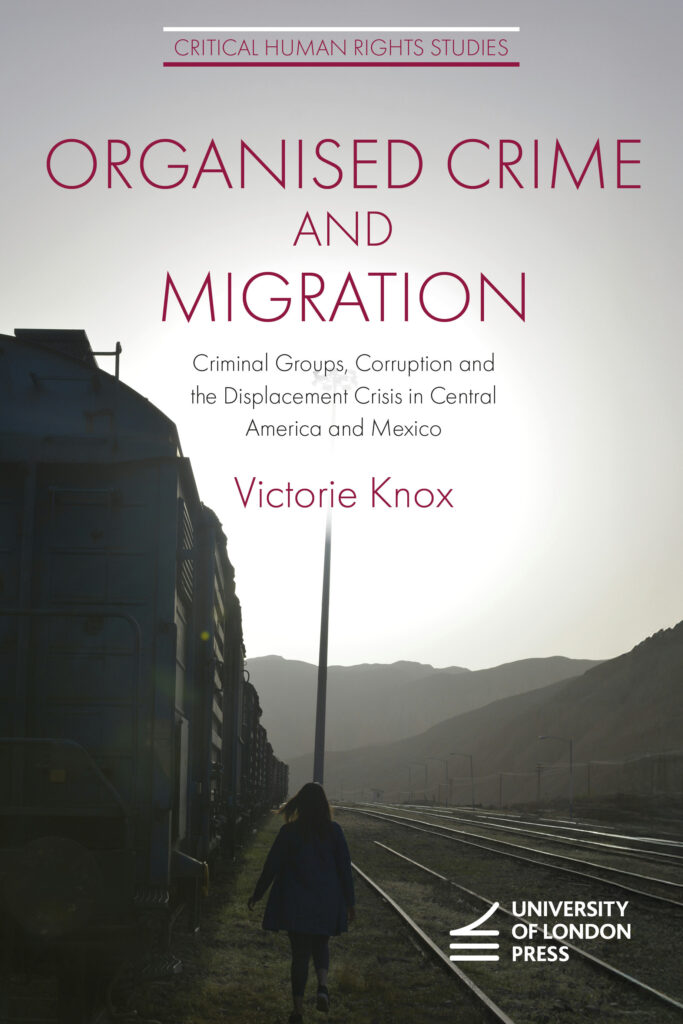
My book, Organised Crime and Migration. Criminal Groups, Corruption and the Displacement Crisis in Central America and Mexico, analyses how organised criminal groups provoke forced migration, exploit migrants and control people-smuggling, the decision-making and displacement dynamics of people affected by gang violence, and the role of policy, corruption and impunity in the evolution and perpetuation of this situation. It provides new insight about the internal and external dimensions of displacement caused by gang violence, the agency of people facing extreme risk, and the foreseeable adverse consequences of policy, as well as the implications for state accountability in relation to these.
The audiences for my book are not just scholars and academics, but practitioners and policymakers concerned with organised crime and migration, including international organisations, think-tanks and agencies working on refugee protection, security policy and migration policy. It has international appeal in Mexico, Central America and the USA, as well as Latin America more broadly, as it relates directly to key dynamics of mobility in the region and the current responses to this that are being developed. On a global level, it is relevant to those working on highly important contemporary themes in other regions of the world, such as people smuggling, migrant deaths during transit, the externalisation of migration controls and international protection/asylum.
Diamond open access benefits my audiences in four key ways:
- Equity of access in Latin America. Open access levels the financial barriers to purchasing the book, for students, academics, practitioners and institutes alike, particularly in Mexico and Central America.
- Language accessibility. My audience in Mexico and other countries in Latin America will benefit significantly from open access because this digital format offers the opportunity to use in-browser translation software to read in Spanish. This will extend access beyond audiences with a strong command of English or who prefer to read in another language.
- Access for practitioners and policy makers. In particular, it will benefit those who come from practice rather than academia, many of whom work for NGOs or civil society and do not have access to academic libraries nor the funds to purchase academic books.
- Flexibility for those in policy and practice. Open access will enable selective reading for (time-constrained) policymakers who may have interest in reading just one chapter of the book but may be discouraged from doing so if they must purchase the whole book.
Publishing with an open access university press a. enables access to those who cannot afford purchase, including academics and practitioners in Mexico and Central America, and b. allows the use of automatic translation in the browser, enabling wider access. I will be doing a launch event in Mexico City in November because of these benefits and the genuine accessibility of my book.
I am finalising a proposal for my second monograph “Designing Ethics and Researcher Wellbeing into Challenging Research”. I am determined to have it published open access because of the significant benefits it brings in terms of equitable access, global access and non-academic practitioner access.
Read, download or purchase Organised Crime and Migration by Victorie Knox
Explore the Critical Human Rights Studies series
Read a review of the book by the Latin American Review of Books, ‘Doing Washington’s dirty work’.