Reflecting on the importance of open access publishing for researchers in Open Access Week 2026 – by Valeria Vitale and Gabriel Bodard
In this series of blog posts, recent UoL Press authors share their own publishing experiences and words of advice and support for new authors, and reflect on the importance of open access publishing for researchers.
Valeria Vitale is Lecturer in Digital Humanities at the University of Sheffield. Gabriel Bodard is Reader in Digital Classics at the Digital Humanities Research Hub and the Institute of Classical Studies at the University of London. They are the editors of Open Data in Ancient and Byzantine Studies, published in association with the Institute of Classical Studies.
1. Tell us about your book with UoL Press.
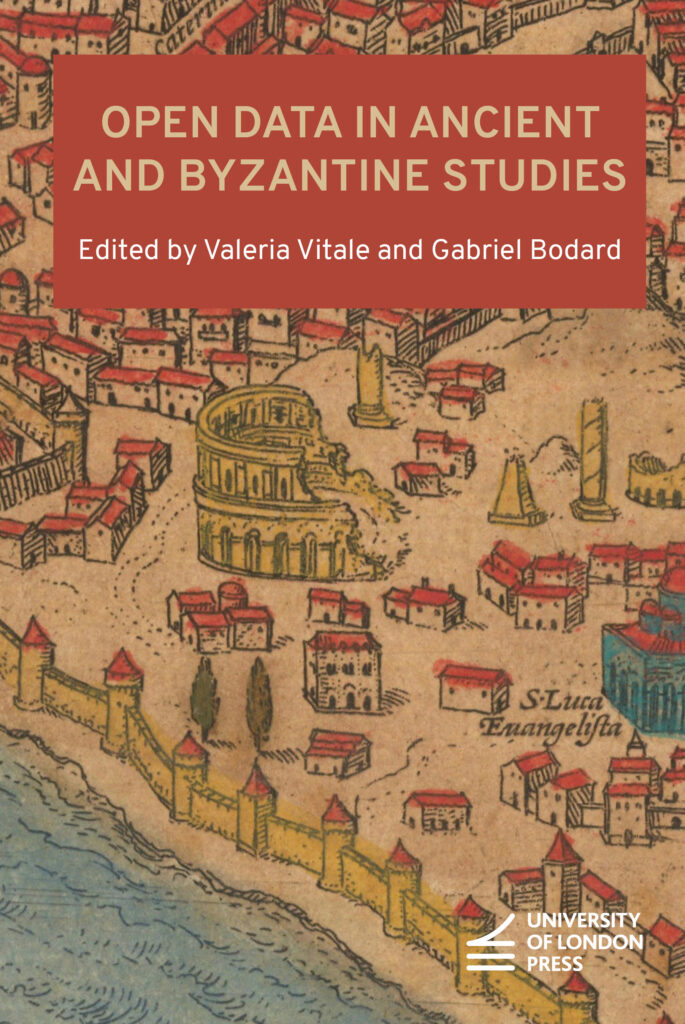
VV: This book shows and discusses the impact that open data, but also open tools, methods and standards, have on research about the ancient world. Through a series of case studies, we argue that open research is not only augmenting size and diversity of our objects of study (for example the growing number of interoperable datasets) but it is also reshaping methodologies and theoretical frameworks. We also wanted to celebrate pioneer projects that really lay the foundations for the excellent work that is being done today internationally, and a new idea of collaboration that is built on re-use and transformation.
GB: As well as a range of different approaches to the use and creation of open data, from navigating open databases to developing and publishing academic interoperability standards, the chapters cover a variety of areas within the fields of ancient and Byzantine studies. Several chapters address prosopographical databases and the linked open data models that enable querying and cross-referencing between them; a few more focus on geographical data, in particular gazetteers of historical places, which raise issues of data interoperability and common standards. Bibliographic data encoding and linguistic approaches to ancient languages are represented as key users of digital and open data, and several chapters draw on the rich field of ancient and mediaeval epigraphy. The discussions that emerge cross all of these disciplinary boundaries, however, and show that interoperability and compatibility of data enables levels of collaboration that enrich all historical research.
2. What advice do you have for authors looking to publish their first book?
GB: I think if you’re publishing your first book, it shouldn’t be a multi-author collected volume! But either way, the most important thing for me would be to have as many eyes on your text as possible during the editing and publication process. Feedback, including both “friendly critical” discussions that help you strengthen your arguments and test your conclusions, and “intelligent layperson” readers who are not experts in your field but still need to be able to understand your words, makes the difference between the ideas in your head as communicated in writing to yourself, and prose that others will understand, be convinced by, and enjoy reading.
VV: But if it is an edited volume, I would say don’t be afraid to be firm with your contributing authors. It is tempting to always be nice and accommodating, but this could easily become a trap and, ultimately, end up being unfair towards the other authors and the publisher. Some colleagues enthusiastically accept an invitation but then realise they don’t really have the time to commit. That is very understandable and nothing to feel uneasy about, so it is better to have honest conversations about expectations, workload and deadlines.
3. Was it important to you to publish your book with an open access university press?
GB: Yes, for us this was a sine que non. Not only because the theme of the volume, Open Data in scholarly publication, would be very ironic to see locked up behind a paywall, and not only because of our personal commitment to OA publishing, but in particular since digital humanities publications by nature need to be disseminated in a timely manner, broadly accessible to a multidisciplinary audience, and findable outside of specific institutions and repositories. While “green” open access is perfect for people who are going to find a work through a reading list or bibliography, only diamond OA can enable truly organic discovery and exposure to the wider audiences that boundary-crossing research relies on.
VV: The choice of an OA publication was very obvious to both of us. In addition, publishing in OA allowed us to make the most of the Manifold web platform, and be able to incorporate dynamic links to external platforms and other digital projects that run on open datasets. So, not only the text of the book is in open access but it is also interactively connected to open data that is externally published. This makes digital humanities publications much clearer and more effective. For example, in our book rather than having a static screenshot of an open dataset to show a fixed, sample search, readers can, on a click, access directly the digital source and try out queries that are actually relevant to them. Manifold also encourages readers to annotate and comment on the book’s chapters, which could become quite useful in group-reading or educational contexts.
Explore their book’s enhanced Manifold edition
4. The theme of International Open Access week is ‘The Cost of Knowledge’. How do you feel diamond open access helps maximise the value and impact of scholarly knowledge for humanities researchers?
VV: It sounds quite uncontroversial to say that research should always be free to read, especially when it is publicly funded. And yet, even as a member of staff of a UK university I have to navigate daily a labyrinth of paywalls. I find it hard to accept, from an ethical perspective, that access to knowledge is systematically denied to the majority of the population, making research an increasingly elitist process. Open Access has really the potential to play a fundamental role in changing these dynamics, and I hope that more and more public funding schemes require scholarly output to be made openly and freely accessible.
GB: Cost to researchers and authors is also a big issue. Gold open access, under the terms of which authors are required to pay or obtain funding for their work to be released under OA, is increasingly difficult to justify, especially in the humanities, where budgets for book processing charges seldom exist any more. Many scholars rely on green open access, where the publications themselves are not open access, but a version of the text (often an earlier draft, and usually after an embargo of up to a couple of years) may be made available in an OA repository; these self-archived versions are harder for potential readers to find, so still a second-class publication. A diamond open access venue still has costs associated with publication, of course, but these are not borne by readers at the point of access, nor by authors wanted to publish. Publishers like UoLP who are able to work with alternative funding streams to enable diamond open access are therefore a godsend for truly open and equitable scholarship.
Read, download or purchase Open Data in Ancient and Byzantine Studies
Explore all of our Classical Studies books