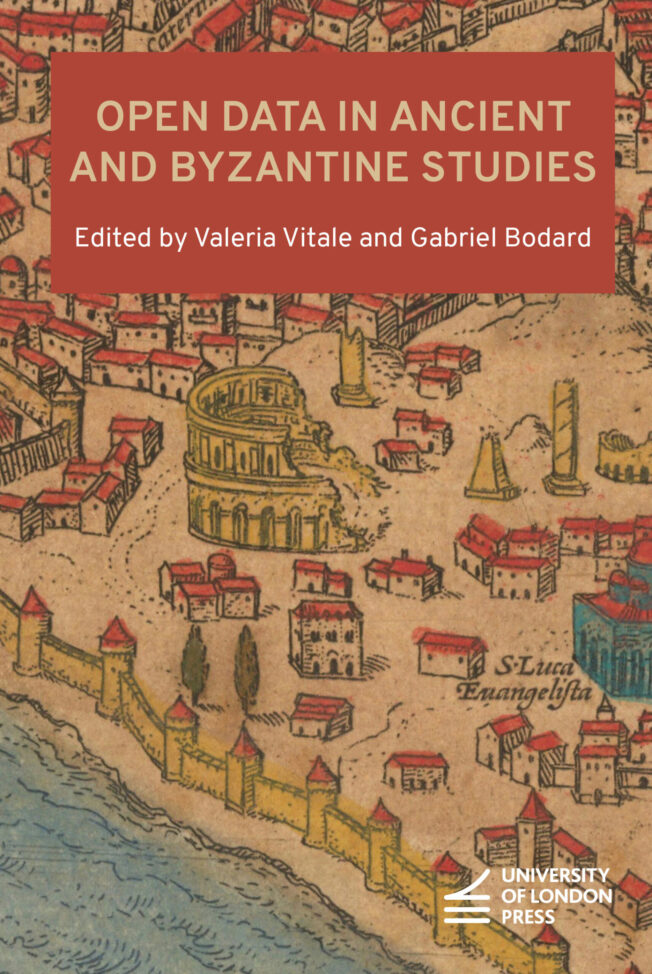

Open Data in Ancient and Byzantine Studies
Valeria Vitale (Editor), Gabriel Bodard (Editor)

Published in association with: Institute of Classical Studies
This volume presents case studies in classical and Byzantine research that exemplify practices, structures and standards in open data which transform and subvert historical scholarship. It leverages new data publication methods and embeds them as part of its argument, exploring the potential of non-linear discourse, multimedia content and data visualisation. Individual chapters illustrate how open scholarship enables a shift from authority-based interpretative frameworks to transparent, collaborative approaches, and combining datasets allows for analysis and comparisons at unprecedented scales, empowers researchers and elicits creative and original responses to old and new research questions.
Collaborative practices and data models lead historians to reflect rigorously and openly on assumptions, definitions and biases, encouraging more diverse approaches to interpretation of ancient sources. The different perspectives, methodologies, disciplines and research questions showcased in this book highlight the role of open data and code in the pursuit of historical research questions and the creation of new knowledge. It demonstrates that methods like linked open data, open licensing, documentation of standards and the publication of code influence the development of open data, tools and workflows, and are in turn nourished by a rich, sustainable classical open data ecosystem.
Open data is fundamental to the future of (digital) scholarship on the ancient world – the chapters in this volume reveal how the challenges of open data are challenges to scholarly method, while also opening doors to new research. These are issues not just for digital classicists, but all who study the ancient world.
—Jonathan Prag, Professor of Ancient History, University of Oxford, UK
-
Introduction
Valeria Vitale and Gabriel Bodard -
1 Historical authority and the prosopography of the Byzantine world: from factoids to assertions
Tara Andrews -
2 Connecting late antiquities: challenges and opportunities for prosopographical data
Charlotte Tupman & Richard Flower -
3 Venetian officals in sixteenth-century Cyprus: An online database and a pilgrimage account
Tassos Papacostas -
4 Connections through collections: linking archaeological and epigraphic archives through places and people
Alessandra Giovenco & Nurdan Atalan Çayırezmez -
5 Engraving the soil: the challenges of defining spatial footprints in Cypriot cultural heritage
Stuart Dunn -
6 You can’t step into the same dataset twice: iterative improvement through reuse of open Libyan place data
Valeria Vitale -
7 The makeup of Ajax: reconstructing networks of interpretation through the commentary tradition
Charles Pletcher & Matteo Romanello -
8 Traces of lost libraries in the works of Alexandrian and Byzantine scholars: bibliographic open data from antiquity to Wikimedia
Monica Berti -
9 Digital epigraphy at Dura-Europos: toward a FAIR-er inscriptional corpus
Anne Hunnell Chen, Carl R. Rice, Ilaria Bucci & Jennifer A. Baird -
10 Reception of Sapphic language in Hadrianic verse epigraphy: building on open philological data
Marja Vierros & Gabriel Bodard -
11 The next decade of Byzantine sigillography: the impact of open data as collaboration
Martina Filosa, Jonathan Shea & Alessio Sopracasa
PDF: 9781912250851
EPUB: 9781912250844
Read Online: 9781912250868
Hardback: 9781912250820 / 268 pages / 240mm x 160mm
Paperback: 9781912250837 / 268 pages / 234mm x 156mm
Valeria Vitale (Editor) 
Valeria Vitale is Lecturer in Digital Humanities at the University of Sheffield. She studies the representation and reception of historical places through a range of digital approaches including gazetteers, linked open data, semantic annotation and 3D visualisation. Before holding this post, she worked at the Institute of Classical Studies, The British Library and The Alan Turing Institute. She is currently focusing on digitised archives documenting archaeological excavations in the Middle East and North Africa.
Gabriel Bodard (Editor)
Gabriel Bodard is Reader in Digital Classics at the Digital Humanities Research Hub and the Institute of Classical Studies at the University of London. He specialises in text encoding for epigraphy and papyrology, linked open data for prosopography and geography, imaging and modelling of cultural heritage, and ancient magic. He has published on digital tools for epigraphy and historical linked open data, and edited several volumes on digital approaches to classics and cultural heritage.
Open data is fundamental to the future of (digital) scholarship on the ancient world – the chapters in this volume reveal how the challenges of open data are challenges to scholarly method, while also opening doors to new research. These are issues not just for digital classicists, but all who study the ancient world.
—Jonathan Prag, Professor of Ancient History, University of Oxford, UK
Subject: Classical Studies, Digital Humanities
BISAC codes: COM018000, HIS002000, HIS059000, SOC019000
Thema codes: GPS, NHA, UXA
Keywords: Ancient Geography, Ancient Greek Language, Byzantine Studies, Data Reuse, Galleries, Libraries, Archives and Museums, Latin Language, Linked Open Data, Open Data, Open Licences, Open Source Software, Prosopography, ancient history, archaeology, cultural heritage, digital humanities, epigraphy
EPUB accessibility:
Accessibility summary
EPUB Accessibility Specification 1.1
Table of contents navigation
Index navigation
Single logical reading order
Short alternative textual descriptions
Full alternative textual descriptions
Print-equivalent page numbering
Use of color is not sole means of conveying information
Next / Previous structural navigation
ARIA roles provided
Appearance of all textual content can be modified
All non-decorative content supports reading without sight
WCAG v2.2
WCAG level AA
Compliance certification by (name)
More books in this subject area
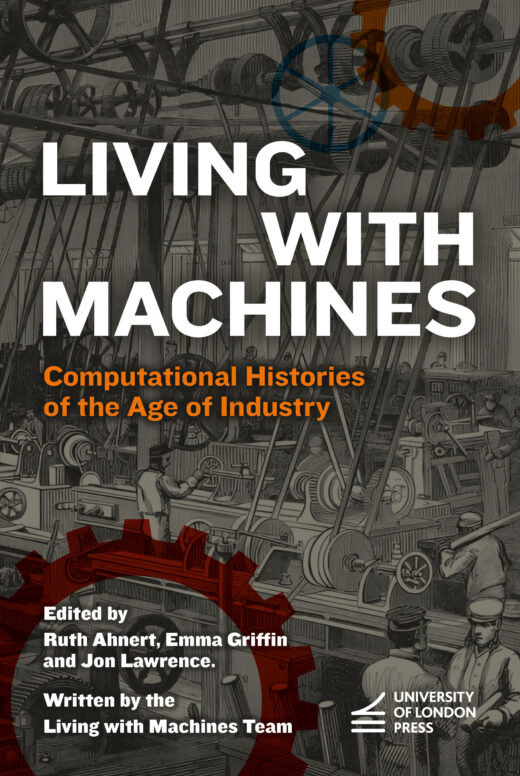
Living with Machines
Ruth Ahnert
Emma Griffin
Jon Lawrence
The Living with Machines Team
12 November 2026

The Agōn in Classical Literature
Michael Edwards
A. Efstathiou
E. Volanaki
Ioanna Karamanou
7 June 2022