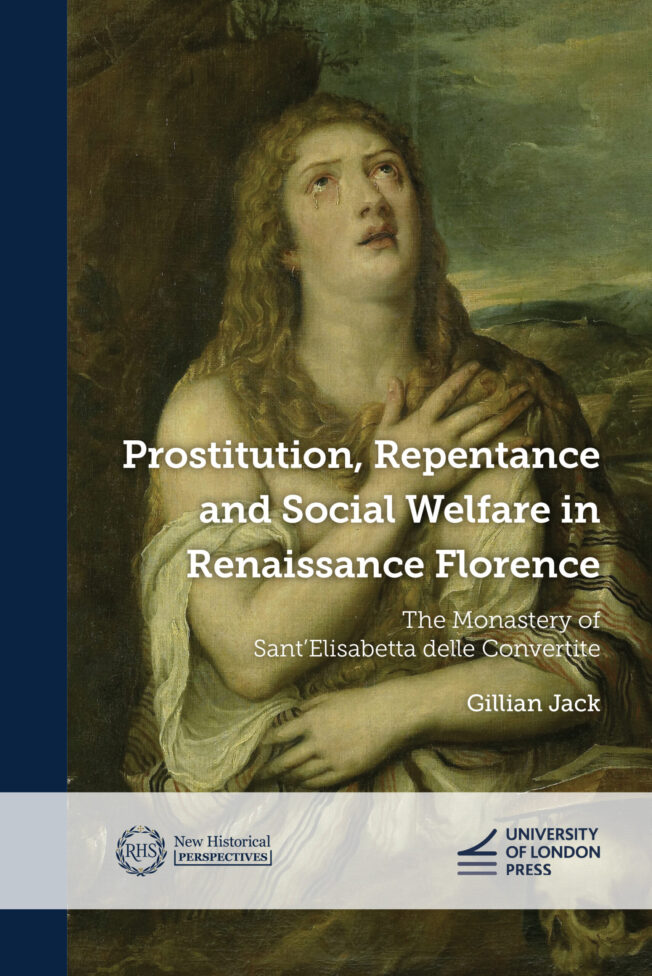

Prostitution, Repentance and Social Welfare in Renaissance Florence
The Monastery of Sant’Elisabetta delle Convertite
Gillian Jack (Author)

Series: New Historical Perspectives
Published in association with: Institute of Historical Research, Royal Historical Society
Open Access publication funded by Jisc Open Access Community Framework
From the fourteenth century, prostitutes in Florence were encouraged to leave their profession and spend their lives in repentance at the monastery of Sant’Elisabetta delle Convertite. Many did over its 500 years, and the monastery was soon one of the most populous in Florence. As the longest enduring monastery for repentant prostitutes, Sant’Elisabetta is an integral part of the history of nuns and of prostitution in the medieval and early modern periods, and had an important place in municipal responses to social welfare and civic morality. It is only by uncovering successive governments’ involvement in Sant’Elisabetta that we can fully understand how the city attempted to manage both prostitution and welfare.
This is the first book-length study to put Sant’Elisabetta into its full historical context. It establishes the place of this often-overlooked nunnery in the wider world of medieval penitential piety, renaissance charity and early modern social welfare, exploring the myriad ways in which the Florentine authorities attempted to stabilise Sant’Elisabetta’s finances and ensure its continued survival. Drawing on diverse archival sources, the book’s long chronological scope offers valuable insights into the broader histories of the relationship between the Florentine state and monastic institutions, public policy, welfare and women in the long Renaissance.
Gillian Jack takes us deep into the workings of one of Florence’s most compelling institutions. Piety and poverty were among the forces shaping Sant’Elisabetta over centuries, but Jack shows how it was above all the women who sheltered there at the shifting margins of acceptability who made it indispensable.
—Nicholas Terpstra, Provost & Vice-Chancellor, Trinity College, University of Toronto, Canada.
-
Introduction
-
1 Prostitution and Repentance in Medieval Context
-
2 The Foundation of Sant’Elisabetta delle Convertite
-
3 Legalised Prostitution and Funding Repentance
-
4 Municipal Funding and Increased Interference
-
5 Making Prostitutes Pay for Sant’Elisabetta
-
6 Sant’Elisabetta, the Law, and Exceptions to It
-
7 A New Era of Financial Stability
-
Conclusion
- Appendix: The Nuns of Sant’Elisabetta delle Convertite
- Bibliography
PDF: 9781911507611
Hardback: 9781908590978 / 224 pages / 240mm x 160mm
Paperback: 9781908590985 / 224 pages / 234mm x 156mm
Gillian Jack (Author) 
Gillian Jack is a historian of late medieval and early modern Italy, with a focus on poor women and girls in Florence. She is currently an Associate Lecturer at The Open University where she has taught history from Greek myth to the 1970s.
Gillian Jack takes us deep into the workings of one of Florence’s most compelling institutions. Piety and poverty were among the forces shaping Sant’Elisabetta over centuries, but Jack shows how it was above all the women who sheltered there at the shifting margins of acceptability who made it indispensable.
—Nicholas Terpstra, Provost & Vice-Chancellor, Trinity College, University of Toronto, Canada.
Subject: History, Religious History
BISAC codes: HIS020000, HIS037020, HIS058000, POL019000, REL084000, SOC032000
Thema codes: JBSF1, NHDL, NHTB, QRVS
Keywords: 14th Century, 15th century, Charity, Florence, Italy, Long Renaissance, early modern, monastic institutions, nunneries, prostitution, public policy, welfare, women
More books in this subject area

Living with Machines
Ruth Ahnert
Emma Griffin
Jon Lawrence
The Living with Machines Team
12 November 2026

Fasti Ecclesiae Anglicanae 1541–1857: The Welsh Dioceses XIV
William H. Campbell
Joyce M. Horn
13 August 2026
Postcards, Translators and Esperanto Pioneers
Guilherme Fians
Bernhard Struck
Claire Taylor
13 November 2025
Atlantic Isles: Travel and Identity in the British and Irish West, 1880–1940
Gareth Roddy
30 October 2025