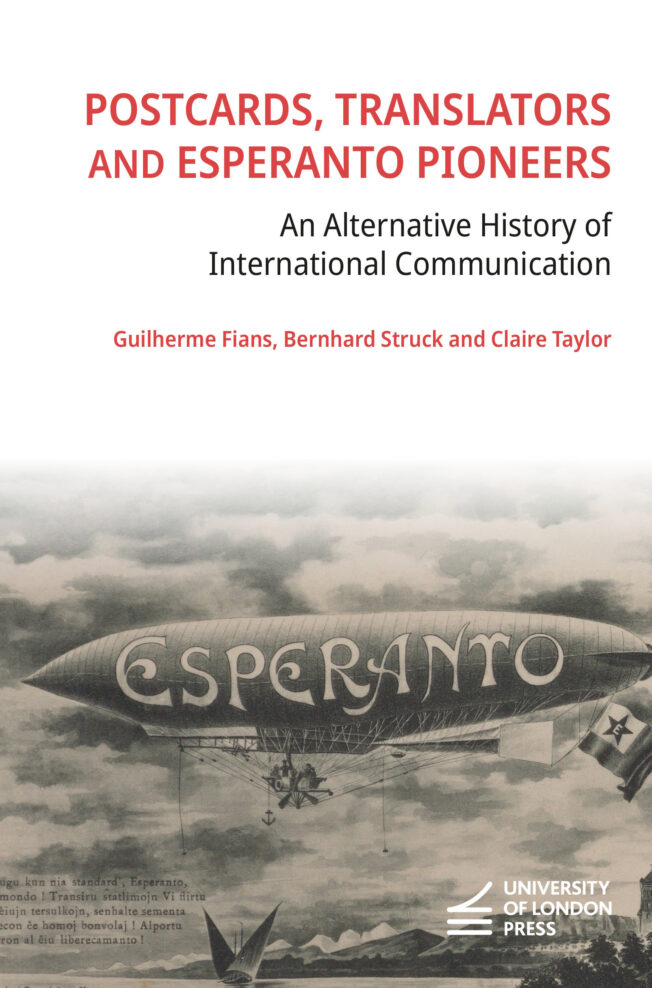

Postcards, Translators and Esperanto Pioneers
An Alternative History of International Communication
Guilherme Fians (Author), Bernhard Struck (Author), Claire Taylor (Author)

Published in association with: Institute of Historical Research
The early twentieth century was a time when steamships, international postal services and the telephone were setting the pace of an early wave of globalisation in Europe. In this increasingly international scenario, what role did language play? To address the geopolitical problem of cross-border linguistic (mis)understanding, international auxiliary languages like Esperanto were created. But what happened to a constructed language when it travelled to different places?
This book tackles these questions by exploring the letters, postcards and activities of John Beveridge (1857–1943) and his family. This Scottish clergyman was a proficient Esperanto speaker, translator and co-founder of several Esperanto organisations. His long-standing engagement with the language left a unique archive that reveals how many Esperanto speakers exchanged letters across borders, produced literature for an international readership, organised congresses and used this language as an entry point into modernity and globalisation from their ‘marginal’ positions in the world.
By tracing this language-based form of grassroots internationalism, the book uncovers wide-reaching networks connecting a corner of Scotland with rural settings and villages in Finland, Bulgaria and Brazil. Ultimately, it asks: what do we learn about international communication and globalisation through the lens of Esperanto and postcards? Focusing on a constructed language and communication technologies that preceded the dominance of global English and social media, this book offers an alternative vantage point on the history of international communication.
Postcards, Translators and Esperanto Pioneers is an interesting tale of a linguistic and social experiment, created and sustained by idealistic men and women, that deserves to be told.
—Graham Elliott, Member of Chartered Institute of Linguists, London, UK
CIOL: Chartered Institute of Linguists
-
Introduction: building worlds with words
-
1 Grassroots internationalism from small places: pen, ink and the forging of friendships in a constructed language
-
2 From learning the language to founding local clubs: the making of an Esperanto speaker
-
3 Gendered talk: Esperanto-speaking women and languages of egalitarianism
-
4 Speaking of the Lord to the master: John Beveridge, Ludwik Zamenhof and the Esperanto translation of the Bible
-
Conclusion: the history of international communication via postcards and Esperanto
PDF: 9781914477904
EPUB: 9781914477911
Read Online: 9781914477898
Hardback: 9781914477874 / 154 pages / 220mm x 144mm
Paperback: 9781914477881 / 154 pages / 216mm x 140mm
Guilherme Fians (Author) 
Guilherme Fians is Lecturer in Social Anthropology and Research Development Officer at the University of Manchester, UK.
Bernhard Struck (Author)
Bernhard Struck is Professor of Modern History at the University of St Andrews, UK.
Claire Taylor (Author)
Claire Taylor is a historian and MPhil student in Heritage Studies at the University of Cambridge, UK.
Postcards, Translators and Esperanto Pioneers is an interesting tale of a linguistic and social experiment, created and sustained by idealistic men and women, that deserves to be told.
—Graham Elliott, Member of Chartered Institute of Linguists, London, UK
CIOL: Chartered Institute of Linguists
Subject: History, Languages, Cultures and Societies
BISAC codes: HIS015000, HIS037070, LAN009000, SOC032000
Thema codes: CBX, GTC, JBSF1, NHTB
Keywords: Esperanto, European, Scotland, community-building, constructed languages, correspondence, exchange, globalisation, history, internationalism, modern, networks, transnational
EPUB accessibility:
Accessibility summary
EPUB Accessibility Specification 1.1
Table of contents navigation
Index navigation
Single logical reading order
Short alternative textual descriptions
Print-equivalent page numbering
Use of color is not sole means of conveying information
Next / Previous structural navigation
ARIA roles provided
Appearance of all textual content can be modified
All non-decorative content supports reading without sight
WCAG v2.2
WCAG level AA
More books in this subject area

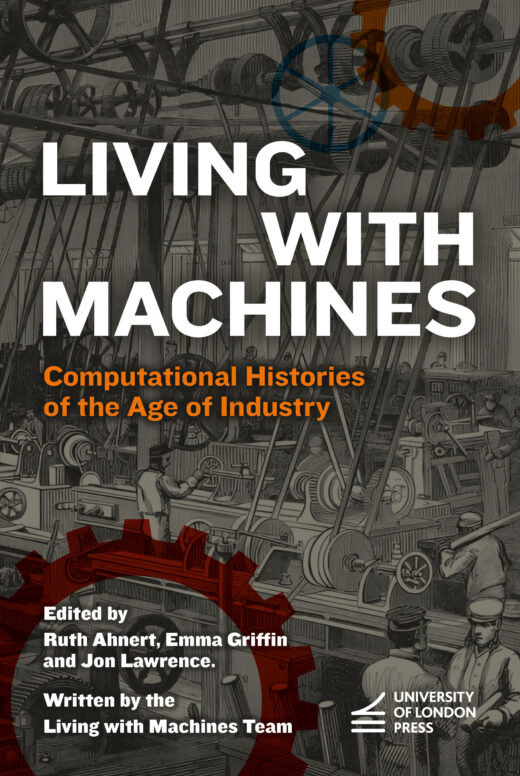
Living with Machines
Ruth Ahnert
Emma Griffin
Jon Lawrence
The Living with Machines Team
12 November 2026

Artificial Intelligence, Art and Indigeneity
Thea Pitman
Sandra De Berduccy
Andreas Rauh
17 September 2026
Fasti Ecclesiae Anglicanae 1541–1857: The Welsh Dioceses XIV
William H. Campbell
Joyce M. Horn
13 August 2026