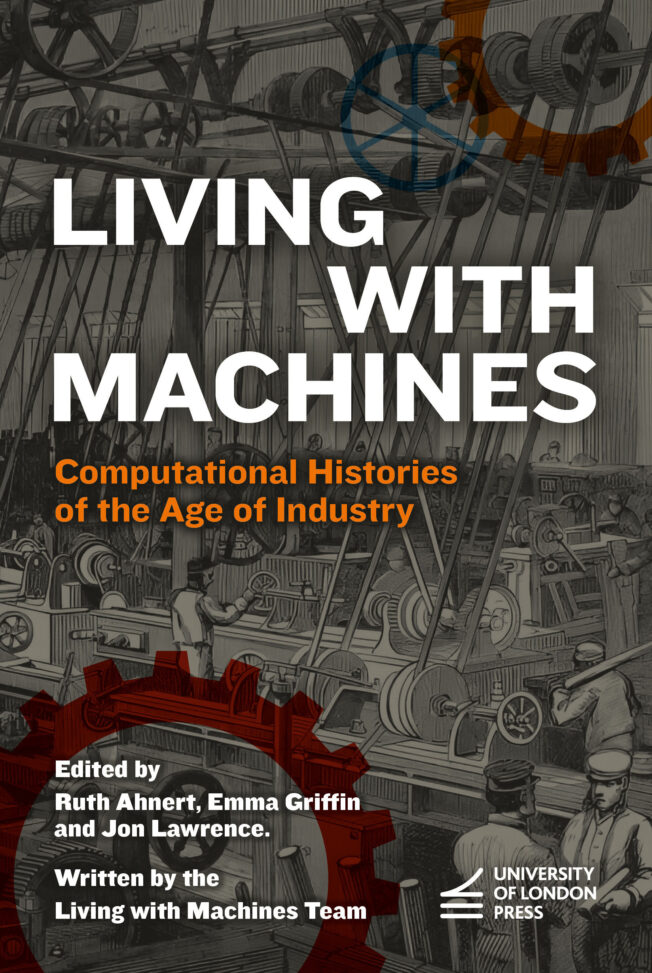

Living with Machines
Computational Histories of the Age of Industry
Ruth Ahnert (Editor), Emma Griffin (Editor), Jon Lawrence (Editor), The Living with Machines Team (Author)

Open Access publication funded by AHRC
Living with Machines is a data-driven history of the coming of the machine age in the long nineteenth century, arising from one of the largest interdisciplinary projects undertaken in the humanities. The world’s first industrial revolution in Britain resulted in an explosion in the creation and collection of documentary sources. This book harnesses the combined power of massive digitised historical collections – from maps and census returns to newspapers – and computational analytical tools to examine the ways in which technology altered the very fabric of human existence on a hitherto unprecedented scale.
Collaboratively written, and developed through open community review, the book features an innovative open access edition enhanced with interactive maps, datasets and visualisations, digital notebooks, and multimedia content including video, audio and images. Its experimental approach uses easily reproducible methods based on open source code and linked to publicly available datasets.
Historians will find in this book a wealth of accessible material illuminating the human, social and cultural consequences of this historical moment. For digital humanists, cultural heritage professionals, librarians and archivists it is a rich example of the potential and methods of making collections available for digital scholarship. At once an exploration of the extraordinary impact of technology on humanity in the age of industry and a powerful digital artefact itself, this book is an essential text at the cutting edge of digital history.
Published open access with funding from the Arts and Humanities Research Council.
A selection of chapters of this title are currently available on our instance of Manifold. Chapters are being released periodically for early access while in open review.
Living with Machines stands as one of the most ambitious collaborations yet undertaken between historians and computational researchers. Beyond the historical interpretations offered here, it leaves an enduring legacy of tools, datasets, workflows, and methodological reflections that will shape how future generations of historians are trained. Anyone interested in bringing historical scholarship into the age of AI—without abandoning the discipline’s commitment to critical interpretation and source criticism—will find this an indispensable resource.
—Jo Guldi, Historian and Professor of Data and Decision Sciences at Emory University, USA.
-
Introduction: working with machines
Ruth Ahnert, Emma Griffin, and Jon Lawrence -
1 The Environmental Scan as a method for digital source criticism at scale
Kaspar Beelen, Ruth Ahnert, Jon Lawrence, Katherine McDonough, Daniel van Strien and Daniel C.S. Wilson -
2 MapReader: software and principles for computational map studies
Katherine McDonough, Ruth Ahnert, Kaspar Beelen, Kasra Hosseini, Jon Lawrence, Valeria Vitale, Kalle Westerling, Daniel C.S. Wilson and Rosie Wood -
3 Beyond the tracks: re-connecting people, places and stations in the history of late-Victorian railways
Joshua Rhodes, Jon Lawrence, Kaspar Beelen, Katherine McDonough and Daniel C.S. Wilson -
4 Links in the chain: workers in the British bicycle boom, as seen from the England and Wales census, 1881–1911
Guy Solomon, Joshua Rhodes, Jon Lawrence, Emma Griffin, Timothy Hobson, Sherman Lo and Daniel C.S. Wilson -
5 Analysing the language of mechanisation in nineteenth-century British newspapers
Barbara McGillivray, Nilo Pedrazzini, Arianna Ciula, Jon Lawrence, Tiffany Ong, Mia Ridge and Miguel Vieira -
Afterword
Ruth Ahnert
PDF: 9781914477669
Read Online: 9781914477652
Hardback: 9781914477638 / 220mm x 144mm
Paperback: 9781914477645 / 216mm x 140mm
Ruth Ahnert (Editor) 
Ruth Ahnert is Professor of Literary History and Digital Humanities at Queen Mary University of London, UK. She has a background as an early modernist, with a particular interest in book history and epistolary culture, and her current research interests include applications of data science to humanistic inquiry. She is author of several books including, The Rise of Prison Literature in the Sixteenth Century (2013), The Network Turn: Changing Perspectives in the Humanities (2020, co-authored with Sebastian E. Ahnert, Catherine N. Coleman, and Scott B. Weingart), and Collaborative Historical Research in the Age of Big Data: Lessons from an interdisciplinary project (2023, co-authored with Emma Griffin, Mia Ridge & Giorgia Tolfo). She was Principal Investigator on the Living with Machines project and is co-series editor of the Text Technologies series.
Emma Griffin (Editor)
Emma Griffin is Professor of British History and Head of School at Queen Mary University of London, UK. She specialises in the social and economic history of Britain during the period 1700–1914. She has written five books, most recently Bread Winner: An Intimate History of the Victorian Economy (2020) and is currently writing a global history of industrialisation. She was President of the Royal Historical Society, 2020–24 and has spent many years engaged in editorial work, serving as editor for History; Historical Journal; Cultural and Social History and the Camden Series.
Jon Lawrence (Editor)
Jon Lawrence is Professor Emeritus at Exeter University. He works on British social, political and cultural history from the mid-nineteenth century to the present. He has published extensively on political language and the culture of public politics and his book Me, Me, Me? The Search for Community in post-war England was published in 2019. He has also worked extensively on the world of popular party politics, playing a prominent role in the development of the so-called 'new political history' with its emphasis on the systematic study of political language. Between 2019 and 2024 he was Co-Investigator on the Living with Machines project.
The Living with Machines Team (Author)
Ruth Ahnert, Kaspar Beelen, Arianna Ciula, Emma Griffin, Timothy Hobson, Kasra Hosseini, Katherine McDonough, Barbara McGillivray, Jon Lawrence, Sherman Lo, Tiffany Ong, Nilo Pedrazzini, Joshua Rhodes, Mia Ridge, Guy Solomon, Daniel van Strien, Miguel Vieira, Valeria Vitale, Kalle Westerling, Daniel C.S. Wilson and Rosie Wood.
Living with Machines stands as one of the most ambitious collaborations yet undertaken between historians and computational researchers. Beyond the historical interpretations offered here, it leaves an enduring legacy of tools, datasets, workflows, and methodological reflections that will shape how future generations of historians are trained. Anyone interested in bringing historical scholarship into the age of AI—without abandoning the discipline’s commitment to critical interpretation and source criticism—will find this an indispensable resource.
—Jo Guldi, Historian and Professor of Data and Decision Sciences at Emory University, USA.
Subject: Digital Humanities, History
BISAC codes: HIS015060, LAN025000
Thema codes: GL, NHTK, UBB
Keywords: Alan Turing Institute, Britain, British Library, Urban history, Victorian, archivists, computational linguists, cultural heritage, data science, digital history, digital humanists, digitisation, industrial revolution, librarianship, machine age
More books in this subject area

Fasti Ecclesiae Anglicanae 1541–1857: The Welsh Dioceses XIV
William H. Campbell
Joyce M. Horn
13 August 2026

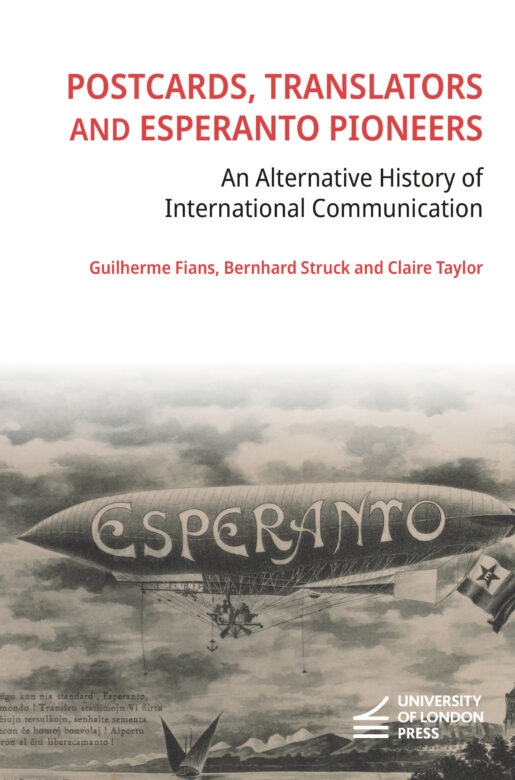
Postcards, Translators and Esperanto Pioneers
Guilherme Fians
Bernhard Struck
Claire Taylor
13 November 2025
