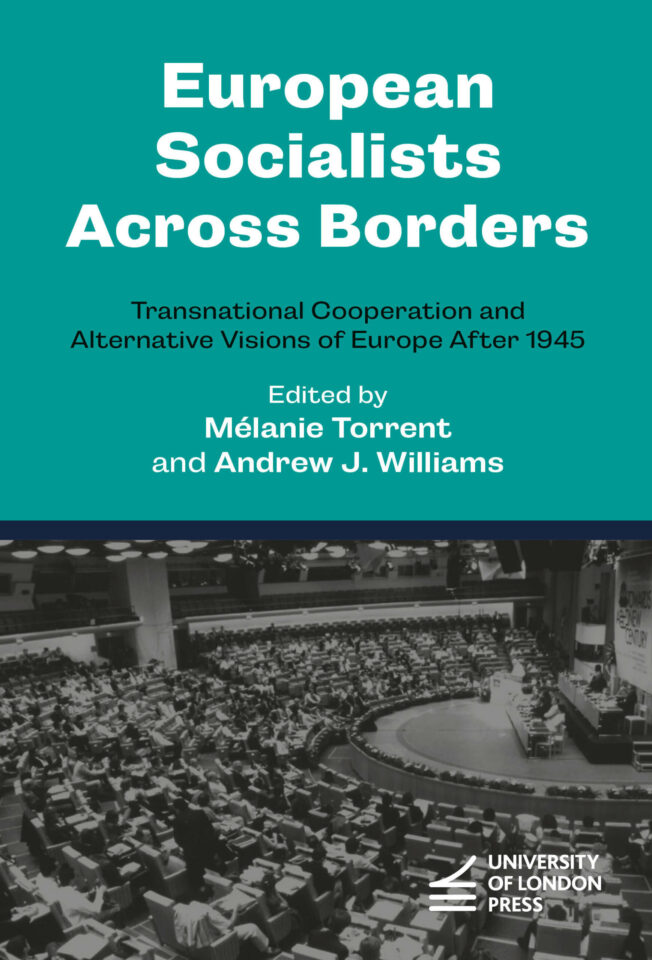

European Socialists Across Borders
Transnational Cooperation and Alternative Visions of Europe After 1945
Mélanie Torrent (Editor), Andrew J. Williams (Editor)

From postwar debates on institutionalised cooperation in Western Europe to the ambitions of the European Union in the post-Cold War era, this volume investigates the impact of socialist networks on European construction and integration, and the role of European socialism in international (dis)orders. It assesses how socialist networks were influenced by relations with socialist parties and groups outside Europe, and how they navigated local, national and global politics. Collectively, the chapters explore four main areas: the relationship between the ideals of European cooperation and daily, routine and domestic politics; the shifting definitions of political elites and popular understandings of Europe, including the influence of people of African, Caribbean and Asian descent on the transformation of socialist thought, policies and practices in the European (ex-) imperial powers; the extent to which European socialists attempted to propose a postcolonial, postimperial agenda for Europe; and how European institutions were used, and with what results, by socialists and their contacts.
Reflecting on the successes and failures of transnational processes of socialisation, the role of cultural intermediaries and bridge-builders, and the reasons behind misunderstandings, failed projects and missed opportunities for peace and equality, the book examines how socialist politicians and activists conceived of Europe’s role in worldmaking in the transition out of conflict and empire. In doing so, the volume contributes to a better understanding of, and support for, cooperation across borders.
The book shows the core role of individual European socialists and their wider social and professional networks in shaping debates on early European integration and decolonisation, nuancing such key concepts as bi-polarity and shifting the focus of our thinking to alternative European (international) policies and roads not taken.
— Brigitte Leucht, Reader in International History and Politics, University of Portsmouth, UK
- Introduction
Mélanie Torrent and Andrew J. Williams
Part I. European socialism in war and peace
* 1 The Labour party and the SFIO in London in the 1940s
Andrew J. Williams * 2 Transwar continuities: The Mouvement Socialiste pour les Etats-Unis d’Europe (MSEUE) and Socialist Networks in the Early Cold War
Benjamin Heckscher and Tommaso Milani
Part II. Paths not taken? European socialists and the politics of worldmaking at the end of empire
- 3 Europe re-imagined? Claude Bourdet, France-Observateur and British critics of the Algerian war
Mélanie Torrent - 4 Social Activism in the Age of Decolonisation: Basil Davidson and the Liberation Struggles in Lusophone Africa, c. 1954–1975
Pedro Aires Oliveira - 5 Olof Palme, Sweden, and the Vietnam war: An outspoken socialist among European socialists
Lubna Z. Qureshi
Part III. Redefining Europe and reassessing Europeanisation: socialist readings of internationalism and liberalism
* 6 European socialists and international solidarity with Palestine: towards a socialist European network of solidarity in the 1970s and 1980s?
Thomas Maineult * 7 Black British Labour Leaders and the Europeanisation of antiracism, 1986–1993
Pamela Ohene-Nyako * 8 From Dark to Light: The Fate of Two European Socialist Employment Initiatives in an Age of Austerity
Mathieu Fulla
PDF: 9781915249739
EPUB: 9781915249746
Read Online: 9781915249722
Hardback: 9781915249708 / 272 pages / 240mm x 160mm
Paperback: 9781915249715 / 272 pages / 234mm x 156mm
Mélanie Torrent (Editor) 
Mélanie Torrent is Professor of British and Commonwealth History at the Université de Picardie Jules Verne in Amiens. She has published on the connected ends of the British and French empires, and British foreign policy in Africa. She has been a senior research fellow at the Institute of Commonwealth Studies since 2011, and a member of the editorial board of the Round Table: The Commonwealth Journal of International Affairs, since 2010.
Andrew J. Williams (Editor)
Andrew J. Williams is Professor (Emeritus) at the School of International Relations at the University of St Andrews, which he joined in 2006. He has been the editor of several journals, including the International History Review (2010–2016), and been a regular invited professor at the Institut d’Etudes Politiques in Lille and at Sciences Po Paris. He has published extensively on international relations, international thought and history, and on the complex relations of the United States, the United Kingdom and France during the twentieth and twenty-first century.
The book shows the core role of individual European socialists and their wider social and professional networks in shaping debates on early European integration and decolonisation, nuancing such key concepts as bi-polarity and shifting the focus of our thinking to alternative European (international) policies and roads not taken.
— Brigitte Leucht, Reader in International History and Politics, University of Portsmouth, UK
Subject: History
BISAC codes: HIS010000, POL005000
Thema codes: JPFF, NHD
Keywords: European Union, decolonisation, diplomacy, empire, internationalism, networks, policy, socialism, transnationalism
EPUB accessibility:
Accessibility summary
Table of contents navigation
Index navigation
Single logical reading order
Short alternative textual descriptions
Print-equivalent page numbering
ARIA roles provided
This publication generally has been produced to meet WCAG Level AA, but it has not been checked for language shifts or for color contrast within images.
More books in this subject area

Living with Machines
Ruth Ahnert
Emma Griffin
Jon Lawrence
The Living with Machines Team
12 November 2026

Fasti Ecclesiae Anglicanae 1541–1857: The Welsh Dioceses XIV
William H. Campbell
Joyce M. Horn
13 August 2026
Postcards, Translators and Esperanto Pioneers
Guilherme Fians
Bernhard Struck
Claire Taylor
13 November 2025
Atlantic Isles: Travel and Identity in the British and Irish West, 1880–1940
Gareth Roddy
30 October 2025