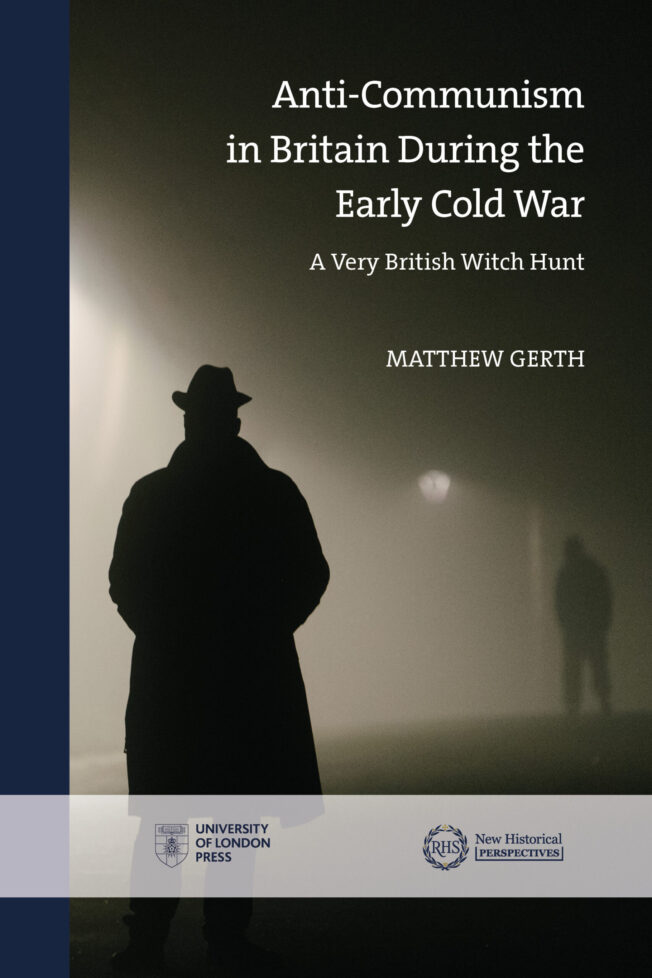

Anti-Communism in Britain During the Early Cold War
A Very British Witch Hunt
Matthew Gerth (Author)

Series: New Historical Perspectives
Published in association with: Institute of Historical Research, Royal Historical Society
The Cold War produced in many countries a form of political repression and societal paranoia which often infected governmental and civic institutions. In the West, the driving catalyst for the phenomenon was anti-communism. While much has been written on the post-war American red scare commonly known as McCarthyism, the domestic British response to the ‘red menace’ during the early Cold War has until now received little attention. Anti-Communism in Britain During the Early Cold War is the first book to examine how British Cold War anti-communism transpired and manifested as McCarthyism raged across the Atlantic.
Drawing from a wealth of archival material, this book demonstrates that while policymakers and politicians in Britain sought to differentiate their anti-communist initiatives from the ‘witch hunt hysteria’ occurring in the United States, they were often keen to conduct – albeit less publicly – their own hunts as well. Through analysing how domestic anti-communism exhibited itself in state policies, political rhetoric, party politics and the trade union movement, it argues that an overreaction to the communist threat occurred. In striking detail, this book describes a nation at war with a specific political ideology and its willingness to use a variety of measures to disrupt or eradicate its influence.
Matthew Gerth leads us into the murky world of anti-communism, revealing how the politics of fear often exposed more about the accuser than the accused. His research, built on extensive archival work, challenges the idea that Britain retained a sense of moderation compared to the U.S., uncovering language, plans, and scenarios that show repressive contingencies and hyperbole were very much part of the story. A persuasive and holistic account that adds depth to our understanding of post-war politics.
Matthew Worley, University of Reading, UK
Introduction
1. British McCarthyism
2. Labour
3. Conservative
4. Pressure Groups
5. Trade Union Movement
Conclusion
PDF: 9781914477386
EPUB: 9781914477362
Read Online: 9781915249494
Hardback: 9781914477348 / 276 pages / 245mm x 163mm
Paperback: 9781914477355 / 276 pages / 234mm x 156mm
Matthew Gerth (Author) 
Matthew Gerth is an associate professor in the School of Law and Political Sciences at the Holy Spirit University of Kaslik, Lebanon. Previously he was a visiting scholar and assistant lecturer in contemporary history at Queen’s University Belfast, UK. He holds a teaching fellowship in the British Academy and has been commissioned as an honorary Kentucky colonel in the state militia – the highest title of honor bestowed by the Governor of Kentucky.
Matthew Gerth leads us into the murky world of anti-communism, revealing how the politics of fear often exposed more about the accuser than the accused. His research, built on extensive archival work, challenges the idea that Britain retained a sense of moderation compared to the U.S., uncovering language, plans, and scenarios that show repressive contingencies and hyperbole were very much part of the story. A persuasive and holistic account that adds depth to our understanding of post-war politics.
Matthew Worley, University of Reading, UK
Subject: British and Irish History, History
BISAC codes: HIS015070, POL036000
Thema codes: NHTB, NHTW
Keywords: Britain, British Housewives League, Cold War, Conservative Party, Labour Party, League of Empire Loyalists, M15, McCarthyism, The Philby Affair, communism, espionage, politics, redbaiting, socialism, spy, trade unions
More books in this subject area

Living with Machines
Ruth Ahnert
Emma Griffin
Jon Lawrence
The Living with Machines Team
12 November 2026

Fasti Ecclesiae Anglicanae 1541–1857: The Welsh Dioceses XIV
William H. Campbell
Joyce M. Horn
13 August 2026
Postcards, Translators and Esperanto Pioneers
Guilherme Fians
Bernhard Struck
Claire Taylor
13 November 2025
Atlantic Isles: Travel and Identity in the British and Irish West, 1880–1940
Gareth Roddy
30 October 2025