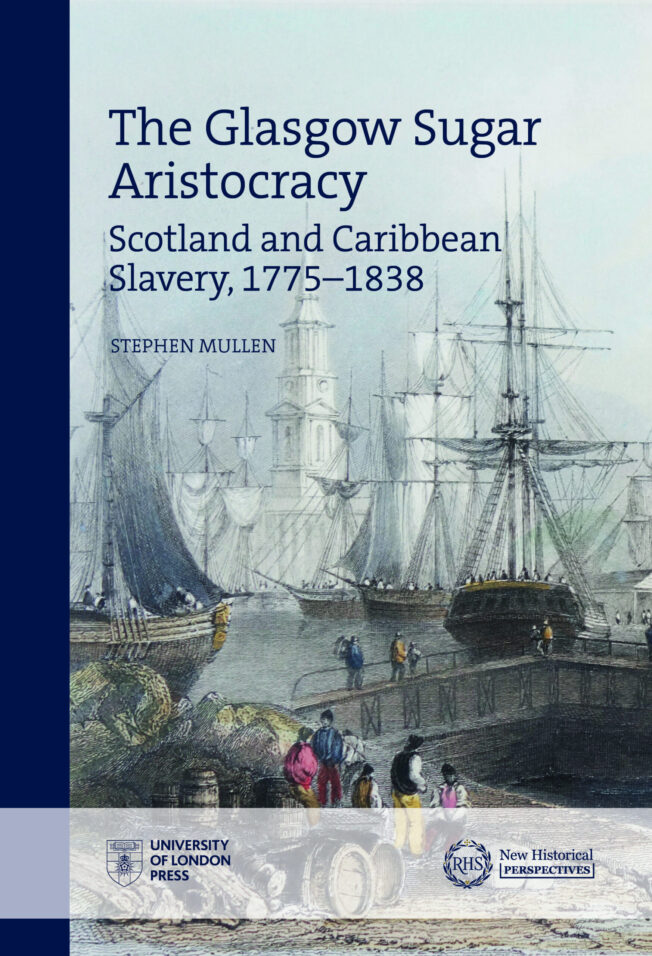

The Glasgow Sugar Aristocracy
Scotland and Caribbean Slavery, 1775–1838
Stephen Mullen (Author)

Series: New Historical Perspectives
Published in association with: Institute of Historical Research, Royal Historical Society
This important book assesses the size and nature of Caribbean slavery’s economic impact in British society. The Glasgow Sugar Aristocracy, a grouping of West India merchants and planters, became active before the emancipation of chattel slavery in the British West Indies in 1834. Many acquired nationally significant fortunes, and their investments percolated into the Scottish economy and wider society. At its core, the book traces the development of merchant capital and poses several interrelated questions during an era of rapid transformation, namely, what impact the private investments of West India merchants and colonial adventurers had on metropolitan society and the economy, as well as the wider effects of such commerce on industrial and agricultural development.
The book also examines the fortunes of temporary Scottish economic migrants who travelled to some of the wealthiest of the Caribbean islands, presenting the first large-scale survey of repatriated slavery fortunes via case studies of Scots in Jamaica, Grenada and Trinidad before emancipation in 1834. It therefore takes a new approach to illuminate the world of individuals who acquired West India fortunes and ultimately explores, in an Atlantic frame, the interconnections between the colonies and metropole in the late eighteenth and early nineteenth centuries.
The Glasgow Sugar Aristocracy provides an excellent examination of Scottish involvement with colonial trade. It is a text that will become core reading for anyone researching Scotland and the Caribbean, … making it an ideal book for researchers, [and] an excellent starting point for new students.
—Kevin Marshall, Stony Brook University, New York, USA
Eighteenth-Century Scotland
The Glasgow Sugar Aristocracy will appeal to an audience beyond readers interested only in the story of Scottish economic development. This book has a moreprofound significance. It forces its readers to confront more difficult truths about how Scots benefitted from the proceeds of enslavement. This excellent book is required reading for anyone interested in Scottish history and understanding Scotland.
**—Dr Matthew Lee, Slavery and Scottish Literature, University of Aberdeen, Scotland and the National Library of Scotland
Bella Caledonia
Mullen’s scholarship and imaginative reconstruction has shaped a book of major importance; an invaluable contribution not only to Scottish history but, more generally, to the ongoing reassessment of the role of slavery in the development and well-being of Scotland and of Britain at large.
—James Walvin, University of York, UK
FAMILY & COMMUNITY HISTORY
1. Introduction 2. Emergence 3. Trade and Commerce 4. A Glasgow-West India House 5. ‘Wanted, to serve in the West Indies’ 6. Jamaica 7. Grenada and Carriacou 8. Trinidad 9. Glasgow-West India ‘Spheres of Influence’: Embedding the Profits of Caribbean Slavery 10. Conclusion Appendix Bibliography and Manuscript Sources
PDF: 9781909646780
EPUB: 9781909646933
Read Online: 9781908590657
Hardback: 9781909646773 / 340 pages / 245mm x 163mm
Paperback: 9781912702336 / 340 pages / 156mm x 234mm
Stephen Mullen (Author)
Dr Stephen Mullen is an historian of slavery and its aftermath in the British Atlantic world, with a particular focus on Scotland and the Caribbean. He is alumnus of the Universities of Strathclyde and Glasgow, completing a PhD at the latter institution in 2015. Since then, he has been a Postdoctoral Researcher and Lecturer in History at the University of Glasgow. His research has focused on the social and economic consequences of Atlantic slavery in a British-Atlantic framework. He was a Postdoctoral Researcher on the Leverhulme project ‘Runaway Slaves in Britain: bondage, freedom and race in the eighteenth century’, and the principal researcher and co-author of the report ‘Slavery, Abolition and the University of Glasgow’ (2018), which led to the sector-leading Reparative Justice strategy. He is currently commissioned by Glasgow City Council to lead an audit of the city of Glasgow’s built heritage and the historic connections with Atlantic slavery.
The Glasgow Sugar Aristocracy provides an excellent examination of Scottish involvement with colonial trade. It is a text that will become core reading for anyone researching Scotland and the Caribbean, … making it an ideal book for researchers, [and] an excellent starting point for new students.
—Kevin Marshall, Stony Brook University, New York, USA
Eighteenth-Century Scotland
The Glasgow Sugar Aristocracy will appeal to an audience beyond readers interested only in the story of Scottish economic development. This book has a moreprofound significance. It forces its readers to confront more difficult truths about how Scots benefitted from the proceeds of enslavement. This excellent book is required reading for anyone interested in Scottish history and understanding Scotland.
**—Dr Matthew Lee, Slavery and Scottish Literature, University of Aberdeen, Scotland and the National Library of Scotland
Bella Caledonia
Mullen’s scholarship and imaginative reconstruction has shaped a book of major importance; an invaluable contribution not only to Scottish history but, more generally, to the ongoing reassessment of the role of slavery in the development and well-being of Scotland and of Britain at large.
—James Walvin, University of York, UK
FAMILY & COMMUNITY HISTORY
Subject: British and Irish History, History
BISAC codes: HIS015090, HIS037050, HIS037060, LAW066000, POL011020, SOC054000
Thema codes: NHTM, NHTS
Keywords: Atlantic trade, British empire, Scotland, economy, sea merchants, sugar
EPUB accessibility:
Accessibility summary
EPUB Accessibility Specification 1.1
Table of contents navigation
Index navigation
Single logical reading order
Short alternative textual descriptions
Full alternative textual descriptions
Print-equivalent page numbering
Use of color is not sole means of conveying information
Next / Previous structural navigation
ARIA roles provided
Appearance of all textual content can be modified
All non-decorative content supports reading without sight
WCAG v2.2
WCAG level AA
Compliance certification by (name)
Read online accessibility:
Table of contents navigation
PDF accessibility:
Table of contents navigation
More books in this subject area

Living with Machines
Ruth Ahnert
Emma Griffin
Jon Lawrence
The Living with Machines Team
12 November 2026

Fasti Ecclesiae Anglicanae 1541–1857: The Welsh Dioceses XIV
William H. Campbell
Joyce M. Horn
13 August 2026
Postcards, Translators and Esperanto Pioneers
Guilherme Fians
Bernhard Struck
Claire Taylor
13 November 2025
Atlantic Isles: Travel and Identity in the British and Irish West, 1880–1940
Gareth Roddy
30 October 2025