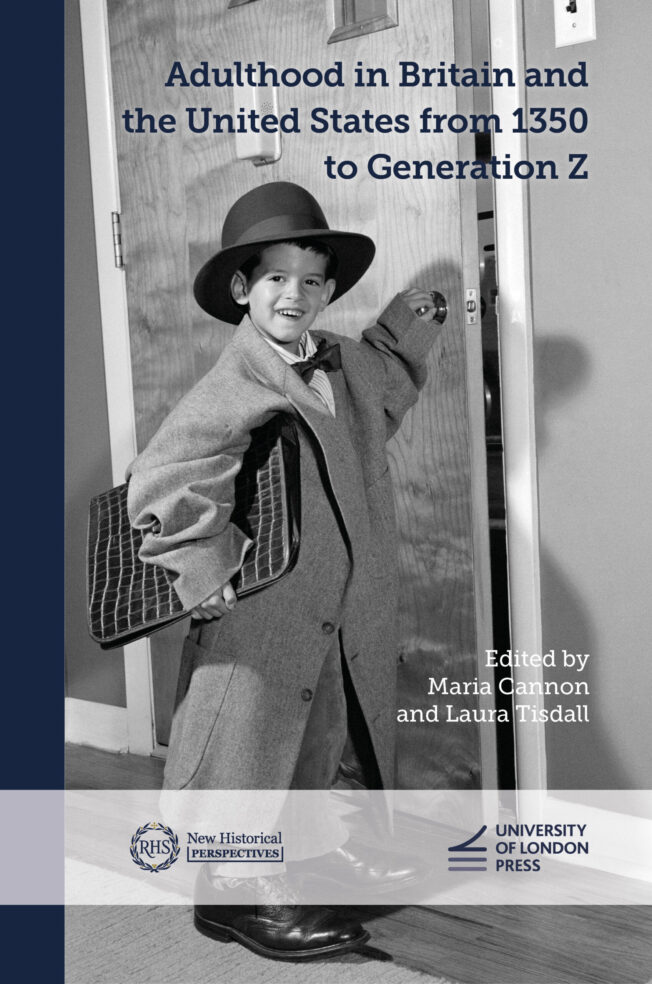

Adulthood in Britain and the United States from 1350 to Generation Z
Maria Cannon (Editor), Laura Tisdall (Editor)

Series: New Historical Perspectives
Published in association with: Institute of Historical Research, Royal Historical Society
Open Access publication funded by Knowledge Unlatched
Adulthood has a history.
This book explores how concepts of adulthood have changed over time in Britain and the United States from 1350 to the present day through eleven case studies. Ideas of adulthood are currently under intense scrutiny, as individuals increasingly reach midlife without necessarily acquiring the ‘traditional’ markers of maturity. Yet this volume shows that this is not a uniquely turbulent period, and it does not represent the overturning of norms that were previously settled and unquestioned. Expectations for adults have altered over time, just as other age-categories such as childhood, adolescence and old age have been shaped by their cultural and social context.
In historicising adulthood, this collection is the first to employ adulthood as a category of historical analysis, arguing that consideration of age is crucial for all scholarship that addresses power and inequality. Collectively, the authors explore four key ideas: adulthood as both burden and benefit; adulthood as a relational category; collective versus individual definitions of adulthood; and adulthood as a static definition.
The book also engages with the intersectional identities of gender, race, class, sexuality and disability, and how these affect understandings of adulthood: who gets to be an adult, and who decides?
This fascinating book brings together the newest scholarship on adulthood. It usefully interrogates how being an adult was defined from the medieval to the modern period, in relation to other life stages, and examines the ways in which age intersected with other categories, to think through dynamics of power and inequality amongst different groups.
— Laura King, Associate Professor of Modern British History, University of Leeds
- Introduction
Maria Cannon and Maria Laura Tisdall - 1 ‘Middle Age’ in the Middle Ages of Western Europe, 1300–1500
Deborah Youngs - 2 ‘The Most Constant and Settled Part of Our Life?’: Adulthood and the Ages of Man in Early Modern England
Maria Cannon - 3 Spiritual Maturity and Childishness in Protestant England, c.1600—1660
Emily E. Robson - 4 The Rising Generation and the Fogram: Locating Adulthood in Eighteenth-Century England
Barbara Crosbie - 5 Seduction Suits and Gendered Adulthood in the Court Systems of the Early United States, 1820–1850
Holly N.S. White - 6 ‘They’re Not Children Anymore’: Juveniles as Adult Defendants in US Criminal Justice, 1786–2000
Jack Hodgson - 7 ‘Childish, Adolescent and Recherché’: Psychoanalysis and Maturity in Psychological Selection Boards, c.1940s–60s
Grace Worrall-Campbell - 8 ”The Pill for the Unmarried Girl is Hardly Going to Improve Her Character”: The Impact of Changing Sexual Behaviours on the Construction of Adulthood in Scotland, c. 1968–1980
Kristin Hay - 9 African-Caribbean and South Asian Adolescents, Adulthood and the ‘Generation Gap’ in Late Cold War Britain, c.1970–c.1989
Laura Tisdall - 10 Marriage, Intimacy and Adulthood in Disabled People’s Lives and Activism in Twentieth-Century Britain
Lucy Delap - 10 A Road of One’s Own: The Rejection of Standard Adulthood in US Emerging Adult Films
Andrea Sofia Regueira Martin - Afterword: Against Adulthood Kristine Alexander
PDF: 9781908590848
EPUB: 9781908590855
Read Online: 9781915249845
Hardback: 9781908590824 / 280 pages / 240mm x 160mm
Paperback: 9781908590831 / 280 pages / 234mm x 156mm
Maria Cannon (Editor) 
Maria Cannon is Senior Lecturer in History at the University of Portsmouth. She is a historian of family, gender, emotions and the life cycle in early modern England. Her current research project Blending the Family: Affection, Obligation and Dynasty in Early Modern English Stepfamilies considers the impact of remarriage on kin networks. She has been a convener of the Life-cycles seminar at the Institute of Historical Research since 2017.
Laura Tisdall (Editor)
Laura Tisdall is Senior Lecturer in History at Newcastle University. She is a historian of childhood, adolescence, adulthood and chronological age in modern Britain and the United States. Her first book A Progressive Education? How Childhood Changed in Mid-Twentieth-Century English and Welsh Schools was published by Manchester University Press in 2020. She is currently working on a book on age and adulthood in Cold War Britain, which is under contract with Yale University Press London.
This fascinating book brings together the newest scholarship on adulthood. It usefully interrogates how being an adult was defined from the medieval to the modern period, in relation to other life stages, and examines the ways in which age intersected with other categories, to think through dynamics of power and inequality amongst different groups.
— Laura King, Associate Professor of Modern British History, University of Leeds
Subject: History
BISAC codes: HIS054000, SOC013000
Thema codes: JBSP3, NHTB
Keywords: adolescence, adulthood, ageing, childhood, chronological age, life course, life-cycle, old age
EPUB accessibility:
Accessibility summary
EPUB Accessibility Specification 1.1
Table of contents navigation
Index navigation
Single logical reading order
Short alternative textual descriptions
Print-equivalent page numbering
Use of color is not sole means of conveying information
Next / Previous structural navigation
ARIA roles provided
Appearance of all textual content can be modified
All non-decorative content supports reading without sight
WCAG v2.2
WCAG level A
Compliance certification by (name)
This publication generally has been produced to meet WCAG Level AA, but it has not been checked for language shifts or for colour contrast within images. Please let us know if you find anything inaccessible within our book as we continue improving our process. You can contact us at uolp.accessibility@london.ac.uk.
More books in this subject area

Living with Machines
Ruth Ahnert
Emma Griffin
Jon Lawrence
The Living with Machines Team
12 November 2026

Fasti Ecclesiae Anglicanae 1541–1857: The Welsh Dioceses XIV
William H. Campbell
Joyce M. Horn
13 August 2026
Postcards, Translators and Esperanto Pioneers
Guilherme Fians
Bernhard Struck
Claire Taylor
13 November 2025
Atlantic Isles: Travel and Identity in the British and Irish West, 1880–1940
Gareth Roddy
30 October 2025