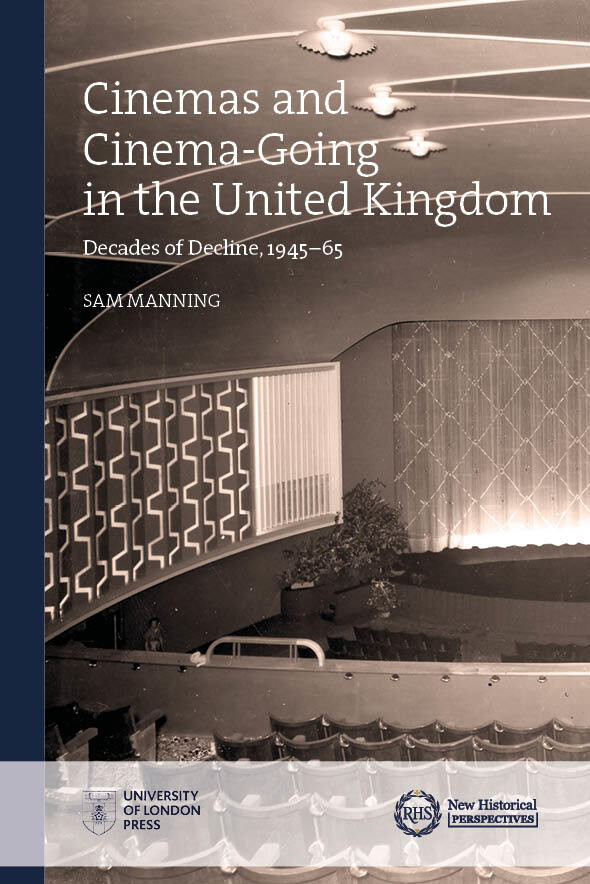

Cinemas and Cinema-Going in the United Kingdom
Decades of Decline, 1945–65
Sam Manning (Author)

Series: New Historical Perspectives
Published in association with: Institute of Historical Research, Royal Historical Society
Open Access publication funded by Knowledge Unlatched
Cinema-going was the most popular commercial leisure activity in the first half of the twentieth century, peaking in 1946 with 1.6 billion recorded admissions. Though ‘going to the pictures’ remained a popular pastime, the transition to peacetime altered citizens’ leisure habits. During the 1950s increased affluence, the growth of television ownership and the diversification of leisure led to rapid declines in attendance. Cinema attendances fell in all regions, but the speed, nature and extent of decline varied widely across the United Kingdom.
By linking national developments to detailed case studies of Belfast and Sheffield, this book adds nuance to our understanding of regional variations in film exhibition, audience habits and cinema-going experiences during a period of profound social and cultural change. Drawing on a wide range of quantitative and qualitative sources, Cinema and Cinema-Going conveys the diverse nature of this important industry, and the significance of place as a determinant of film attendance in post-war Britain.
Dr Sam Manning teaches at Queen’s University Belfast and is a postdoctoral researcher on the AHRC European Cinema Audiences project at Oxford Brookes University. He has recently published articles on the history of cinemas in Northern Ireland in Cultural and Social History and Media History.
A significant addition to the cultural and social history of the United Kingdom. This well-documented study is an addition to the history of British cinema and post-World War II leisure culture… This book is an important read for students and historians of cultural and social history.
Studies in European Cinema
An excellent addition to the wider publications produced under the ‘New Cinema History’ banner. Exploring the everchanging nature of Britain’s film industry and its products has been a point of interest for some time amongst film scholars, but only in the most recent decade have cinema attendance and viewer experiences become a central point of research. Manning’s publication builds upon the ideas of several prominent film scholars, like Sue Harper, Vincent Porter and Stuart Hanson. Utilising qualitative and quantitative evidence, Manning addresses a series of social, economic and political factors to further understand the decline of regional cinemas in the UK from 1945–1965.
Eras Journal
“It is this kind of detailed microhistory of cinemas and the cinema-going that enables a loosening of more uniform accounts… Manning’s thorough approach to the topic enables new perspectives to emerge. His detailed mapping of the two case studies, pulling together a rich yet disperse constellation of sources, including a variety of useful tables and appendices offering a comprehensive list of cinemas in Belfast and Sheffield, provides a rich resource for future researchers.”-Journal of British Studies
Journal of British Studies
“Manning has offered a detailed explanation of cinema-going habits in the post-War UK that provides a point of departure for further scholarship—much in the same way Annette Kuhn and Jeffrey Richards did for the 1930s ‘Golden Age’ of British cinema-going. The book is of great value to historians concerned with cinema-going in the UK and offers much for historians of post-war leisure, entertainment, and the cultural industries.”
–Twentieth Century British History
Introduction
1. Cinema-going experiences 2. The decline of cinema-going 3. Cinema-going and the built environment 4. Cinema exhibition, programming and audience preferences in Belfast 5. Film exhibition in post-war Sheffield Conclusion
PDF: 9781912702367
EPUB: 9781912702381
Read Online: 9781915249487
Hardback: 9781912702343 / 245mm x 163mm
Paperback: 9781912702350 / 234mm x 156mm
Sam Manning (Author)
A significant addition to the cultural and social history of the United Kingdom. This well-documented study is an addition to the history of British cinema and post-World War II leisure culture… This book is an important read for students and historians of cultural and social history.
Studies in European Cinema
An excellent addition to the wider publications produced under the ‘New Cinema History’ banner. Exploring the everchanging nature of Britain’s film industry and its products has been a point of interest for some time amongst film scholars, but only in the most recent decade have cinema attendance and viewer experiences become a central point of research. Manning’s publication builds upon the ideas of several prominent film scholars, like Sue Harper, Vincent Porter and Stuart Hanson. Utilising qualitative and quantitative evidence, Manning addresses a series of social, economic and political factors to further understand the decline of regional cinemas in the UK from 1945–1965.
Eras Journal
“It is this kind of detailed microhistory of cinemas and the cinema-going that enables a loosening of more uniform accounts… Manning’s thorough approach to the topic enables new perspectives to emerge. His detailed mapping of the two case studies, pulling together a rich yet disperse constellation of sources, including a variety of useful tables and appendices offering a comprehensive list of cinemas in Belfast and Sheffield, provides a rich resource for future researchers.”-Journal of British Studies
Journal of British Studies
“Manning has offered a detailed explanation of cinema-going habits in the post-War UK that provides a point of departure for further scholarship—much in the same way Annette Kuhn and Jeffrey Richards did for the 1930s ‘Golden Age’ of British cinema-going. The book is of great value to historians concerned with cinema-going in the UK and offers much for historians of post-war leisure, entertainment, and the cultural industries.”
–Twentieth Century British History
Subject: History, Social and Cultural History
BISAC codes: HIS015070, PER004030
Thema codes: ATFA, NH
Keywords: cinema, leisure, post-war, programming, television
EPUB accessibility:
Accessibility summary
EPUB Accessibility Specification 1.1
Table of contents navigation
Index navigation
Single logical reading order
Short alternative textual descriptions
Full alternative textual descriptions
Print-equivalent page numbering
Use of color is not sole means of conveying information
Next / Previous structural navigation
ARIA roles provided
Appearance of all textual content can be modified
All non-decorative content supports reading without sight
WCAG v2.2
WCAG level AA
Compliance certification by (name)
More books in this subject area

Living with Machines
Ruth Ahnert
Emma Griffin
Jon Lawrence
The Living with Machines Team
12 November 2026

Fasti Ecclesiae Anglicanae 1541–1857: The Welsh Dioceses XIV
William H. Campbell
Joyce M. Horn
13 August 2026



Postcards, Translators and Esperanto Pioneers
Guilherme Fians
Bernhard Struck
Claire Taylor
13 November 2025

Atlantic Isles: Travel and Identity in the British and Irish West, 1880–1940
Gareth Roddy
30 October 2025