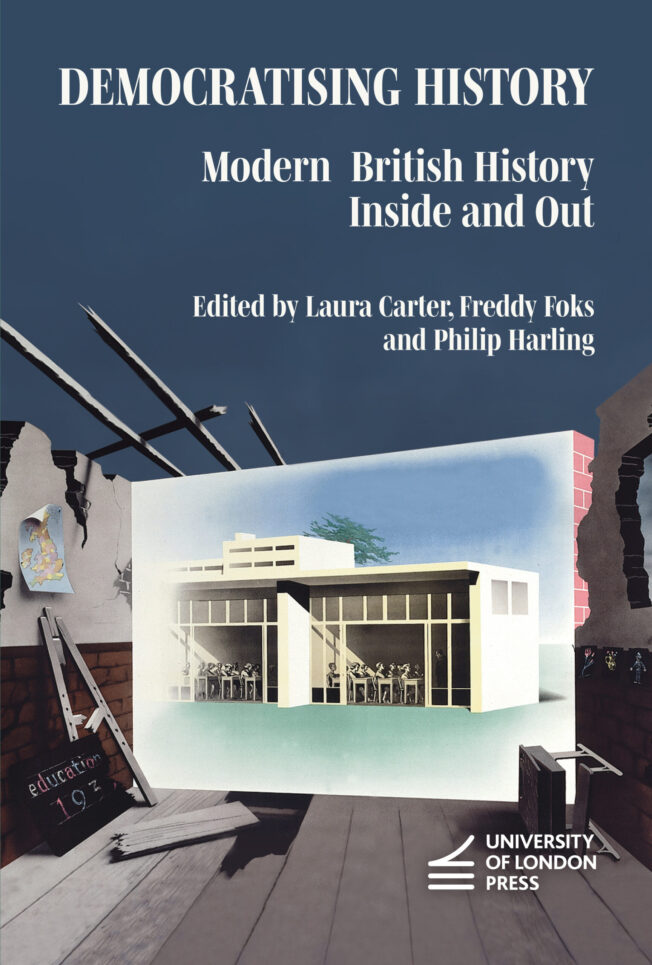

Democratising History
Modern British History Inside and Out
Laura Carter (Editor), Freddy Foks (Editor), Philip Harling (Editor)

Published in association with: Institute of Historical Research
How has democracy transformed modern Britain and the way we teach its history? Democratising History answers this question by showcasing how scholars have successfully united social and cultural histories of democracy in British history. Nine research-led chapters provide an ‘inside’ perspective on democracy in modern British history, covering the complex relationship between Britain and its Empire, the democratisation of metropolitan culture, and how experts aimed to inform public debate in a changing democratic society. An ‘outside’ perspective is brought by six interludes that engage with the democratising forces at work in the twenty-first-century academy that are reshaping the profession, and thus the histories that scholars produce. In bringing these two histories of democracy together within a single conceptual framework, this book narrates an important shift in the landscape of UK higher education from the ‘inside’ and the ‘outside’, insisting that professional and intellectual changes must be seen alongside one another. Collectively, this volume responds to the scholarly and professional contributions of Peter Mandler, whose sensitive readings of cultural discourses and their social reach has inspired a generation of modern British historians. Through novel methods, insightful case studies and broader reflections on the profession, it shows how modern British history is being transformed by these questions and wider social and economic changes in contemporary Britain.
Peter Mandler’s interests have swaggered across two centuries and varied sites in modern British history – from the comprehensive school to the country house, from Westminster and Whig salons to the postwar town centre. He has embraced political history, cultural history, intellectual history, and the history of anthropology and the social sciences. His range and rigour are reflected in this fine festschrift, Democratising History. The masterful introduction sets the ample scene. Five ‘interludes’ testify to the exuberant generosity of Mandler’s intellectual fellowship and the energy and grit of his administrative service to the profession and the subject. Nine crisp chapters by Mandler’s former PhD students cover a cornucopia of topics from the mechanics of the art market to public housing, from Victorian ideas of democracy to reckoning with ‘the Orient’, from the secondary modern to the new sciences of sociological and anthropological observation. It brims with new research and shiny nuggets. (Who knew that the prostitutes of the wartime West End were known as ‘Piccadilly Commandoes’?) This collection is a fitting monument to Mandler’s unique contribution to the history profession, but also to his intellectual reach, or rather (to use a term he popularised) his ‘throw’.
— Amanda Vickery, Professor of Early Modern History, Queen Mary University of London, UK
-
Introduction: Democratising history inside and out
Laura Carter and Freddy Foks -
Interlude a. New Challenges: Teaching Modern History in a ‘new university’
Iwan Morgan -
Part I. Victorian Britain, progress, and the wider world
-
1 Opium, ‘civilisation’, and the Anglo-Chinese Wars, 1839–1860
Philip Harling -
2 Archibald Alison’s Revolution
Ben Weinstein -
Interlude b. Peter and the Special Relationship
Deborah Cohen, Guy Ortolano and Susan Pedersen -
Part II. Culture, consumption and democratisation in Britain since the nineteenth century
-
Interlude c. Olden Times and Changing Times: Museum interpretation and display in twenty-first century Britain
Rebecca Lyons -
3 Painting for pleasure: The rise and decline of the amateur artist in Victorian Britain
Sally Woodcock -
4 Collecting for the Nation: The National Art Collections Fund and the gallery-visiting public in interwar Britain
Heidi Egginton -
Interlude d. Professionalisation, publishing and policy: Peter Mandler and the Royal Historical Society
Margot Finn and Richard Fisher -
Part III. ‘Experts’ and their publics in twentieth-century Britain
-
Interlude e. Accountability and double counting in research funding for UK higher education: The case of the Global Challenges Research Fund
Ambreena Manji -
5 Reluctant pioneers: British anthropologists amongst the Natives of Modern Japan, c. 1929–1930
Chika Tonooka -
6 An American Mass Observer among the natives: Robert Jackson Alexander in World War Two Britain
Lawrence Black -
7 Architecture and sociology: Oliver Cox and Mass Observation
Otto Saumarez Smith -
8 Re-reading “race relations research”: Journalism, social science, and separateness
Christopher Hilliard -
Interlude f. The Historical Association, schools, and the history curriculum
Andrew Stacey-Chapman and Rebecca Sullivan -
9 ‘Democracy’ and ‘expertise’ in two secondary modern schools in Liverpool, 1930–1967
Rosie Germain
PDF: 9781915249920
EPUB: 9781915249937
Read Online: 9781915249913
Hardback: 9781915249890 / 290 pages / 240mm x 160mm
Paperback: 9781915249906 / 290 pages / 234mm x 156mm
Laura Carter (Editor)
Laura Carter is an historian of modern Britain whose work focuses on histories of education, gender, and social change. Her first book, Histories of Everyday Life: The Making of Popular Social History in Britain, 1918-1979 (2021) was nominated for the Royal Historical Society Whitfield Book Prize, 2022. She is now working on a project about secondary education and social change in the United Kingdom since 1945.
Freddy Foks (Editor)
Freddy Foks is an historian of the human sciences, migration and modern Britain. His first book is Participant Observers: Anthropology, Colonial Development, and the Reinvention of Society in Britain (2023). He is now working on a project on subsidised emigration.
Philip Harling (Editor)
Philip Harling is an historian of modern Britain and the British empire whose work focuses on politics, administration, and state formation. He is the author of Rethinking ‘Old Corruption: The Politics of Economical Reform in Britain 1779–1846 (1996), The Modern British State: An Historical Introduction (2001) and Managing Mobility: The British Imperial State and Global Migration, 1840–1860 (2024).
Peter Mandler’s interests have swaggered across two centuries and varied sites in modern British history – from the comprehensive school to the country house, from Westminster and Whig salons to the postwar town centre. He has embraced political history, cultural history, intellectual history, and the history of anthropology and the social sciences. His range and rigour are reflected in this fine festschrift, Democratising History. The masterful introduction sets the ample scene. Five ‘interludes’ testify to the exuberant generosity of Mandler’s intellectual fellowship and the energy and grit of his administrative service to the profession and the subject. Nine crisp chapters by Mandler’s former PhD students cover a cornucopia of topics from the mechanics of the art market to public housing, from Victorian ideas of democracy to reckoning with ‘the Orient’, from the secondary modern to the new sciences of sociological and anthropological observation. It brims with new research and shiny nuggets. (Who knew that the prostitutes of the wartime West End were known as ‘Piccadilly Commandoes’?) This collection is a fitting monument to Mandler’s unique contribution to the history profession, but also to his intellectual reach, or rather (to use a term he popularised) his ‘throw’.
— Amanda Vickery, Professor of Early Modern History, Queen Mary University of London, UK
Subject: History
BISAC codes: HIS015060, HIS015070, HIS035000, HIS054000
Thema codes: NHTB
Keywords: Intellectual History, Modern Britain, Progress, Victorian, culture, democracy, education, empire, experts, historian, profession, society, university
EPUB accessibility:
Accessibility summary
EPUB Accessibility Specification 1.1
Table of contents navigation
Index navigation
Single logical reading order
Short alternative textual descriptions
Full alternative textual descriptions
Print-equivalent page numbering
Use of color is not sole means of conveying information
Next / Previous structural navigation
ARIA roles provided
Appearance of all textual content can be modified
All non-decorative content supports reading without sight
WCAG v2.2
WCAG level AA
More books in this subject area

Living with Machines
Ruth Ahnert
Emma Griffin
Jon Lawrence
The Living with Machines Team
12 November 2026

Fasti Ecclesiae Anglicanae 1541–1857: The Welsh Dioceses XIV
William H. Campbell
Joyce M. Horn
13 August 2026
Postcards, Translators and Esperanto Pioneers
Guilherme Fians
Bernhard Struck
Claire Taylor
13 November 2025
Atlantic Isles: Travel and Identity in the British and Irish West, 1880–1940
Gareth Roddy
30 October 2025