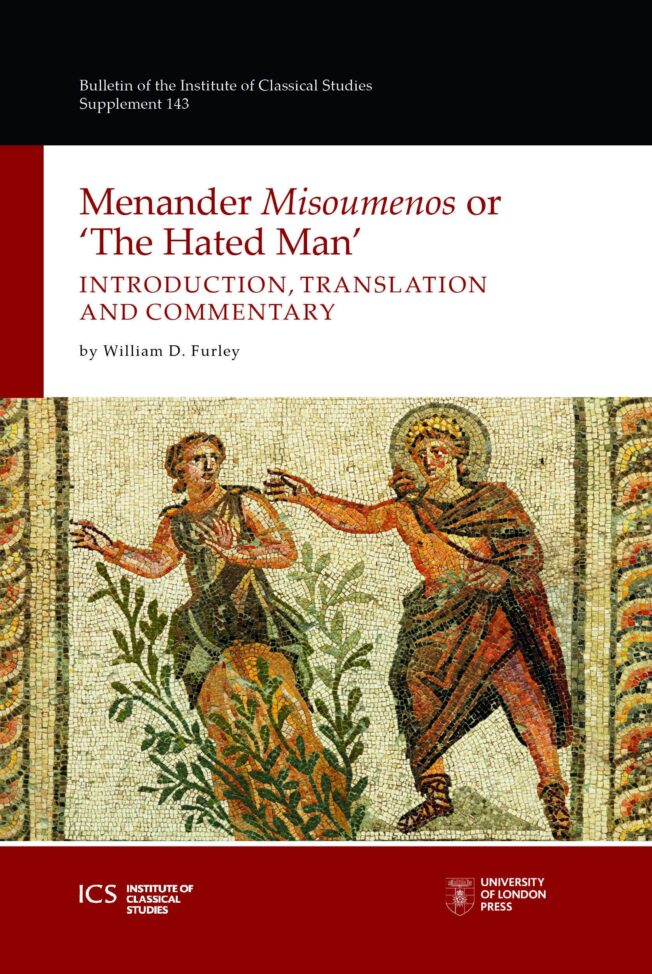
Menander ‘Misoumenos’ or ‘The Hated Man’
Introduction, Translation, and Commentary
William D. Furley (Author)
Series: Bulletin of the Institute of Classical Studies Supplements
Published in association with: Institute of Classical Studies
Menander’s Misoumenos, or ‘The Hated Man’, is one of his most popular plays to have survived from classical times, to judge from the numerous recovered papyrus fragments. Dating to approximately 300 BCE, it tells the story of a mercenary soldier and the captive girl he acquires whilst on campaign in Cyprus. The play follows the soldier’s growing despair as the girl spurns his advances and slowly turns against him, culminating in his suicidal thoughts.
The play belongs to the ancient genre of New Comedy, of which Menander was the acknowledged master. This edition is the fullest to date of any English language edition of the play. It aims to restore as much as possible of the action of Misoumenos, reconstructing language, stagecraft and theatrical dialogue of the original, but always distinguishing what we can be relatively sure of, from hypothesis and reconstruction. Some sections can be restored nearly fully, permitting access to brilliantly original theatrical dialogue which had been lost for over two millennia. Apart from metre and sophisticated idiom, the themes of love, despair and sadness that Menander treats are utterly timeless. This edition aims to present a significantly updated text.
…cette nouvelle édition du Misoumenos, comédie malaisée à établir en raison de sa transmission fragmentaire, facilite grandement l’accès au texte, contribue à une meilleure compré- hension de la pièce dans son ensemble et enrichit le débat par les choix d’édition et d’interprétation originaux. …this new edition of Menander’s Misoumenos, a play whose reconstruction is hampered by its poor state of preservation, greatly facilitates access to the text, contributes to a better understanding of the play as a whole, and enriches the discussion with its innovative editorial and interpretive choices.
—Marie Christians, University of Liège, Dept. of Sciences de l’antiquité, Papyrologie grecque et latine, Mondes anciens.
The commentary is a treasure trove of insights (philological, papyrological, historical, literary, and dramaturgical). …This edition and commentary (absent really significant new papyrus finds) will undoubtedly be the standard for decades to come.
—Niall W. Slater, Emory University, Atlanta, USA
Bryn Mawr Classical Review
Introduction
1.1 The state of play 1.1.1 What do we know? 1.1.2 What do we not know? 1.1.3 The puzzling middle section 1.1.4 The scene of action 1.2 What is the play about? – Thrasonides 1.3 Other Characters 1.3.1 Krateia 1.3.2 Demeas 1.3.3 Kleinias 1.3.4 Getas 1.3.5 Chrysis 1.4 Pictorial evidence 1.5 Legal Framework 1.6 Staging 1.7 Dating 1.8 Metre 1.9 Transmission of the Text 1.9.1 Antiquity 1.9.2 Modern Age 1.10 Technical points about this edition
2 Text Manuscripts The cast Text Unplaced papyrus fragments Miscellaneous unplaced fragments
3 Composite Readings
4 Translation
5 Commentary Act One Act Two Act Three Act Four Act Five
Book Fragments
Bibliography
Index of Main Passages Cited
Index of Greek words
Hardback: 9781905670970 / 262 pages / 244mm x 170mm
William D. Furley (Author)
…cette nouvelle édition du Misoumenos, comédie malaisée à établir en raison de sa transmission fragmentaire, facilite grandement l’accès au texte, contribue à une meilleure compré- hension de la pièce dans son ensemble et enrichit le débat par les choix d’édition et d’interprétation originaux. …this new edition of Menander’s Misoumenos, a play whose reconstruction is hampered by its poor state of preservation, greatly facilitates access to the text, contributes to a better understanding of the play as a whole, and enriches the discussion with its innovative editorial and interpretive choices.
—Marie Christians, University of Liège, Dept. of Sciences de l’antiquité, Papyrologie grecque et latine, Mondes anciens.
The commentary is a treasure trove of insights (philological, papyrological, historical, literary, and dramaturgical). …This edition and commentary (absent really significant new papyrus finds) will undoubtedly be the standard for decades to come.
—Niall W. Slater, Emory University, Atlanta, USA
Bryn Mawr Classical Review
Subject: Classical Literature and Drama, Classical Studies
BISAC codes: ART015060, DRA006000, FOR033000, HIS002010
Thema codes: DBSG, DSBB
Keywords: Athenian life, Greek polis, Menander, New Comedy, ancient theatre, comedy
More books in this subject area

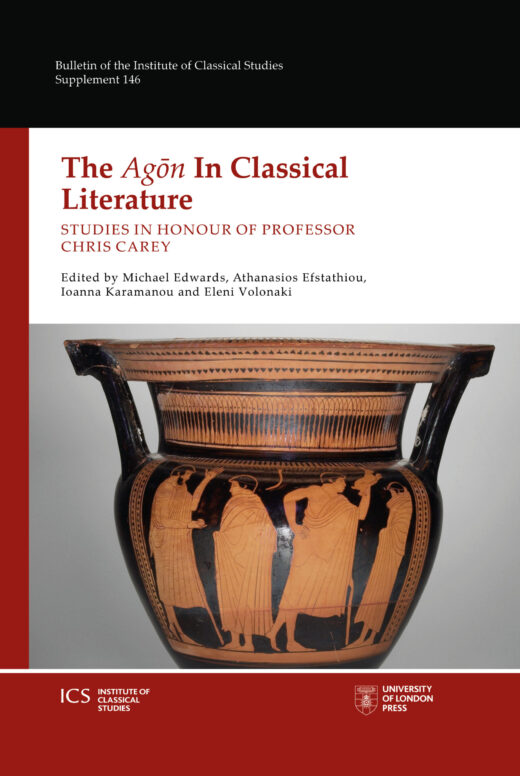
The Agōn in Classical Literature
Michael Edwards
A. Efstathiou
E. Volanaki
Ioanna Karamanou
7 June 2022