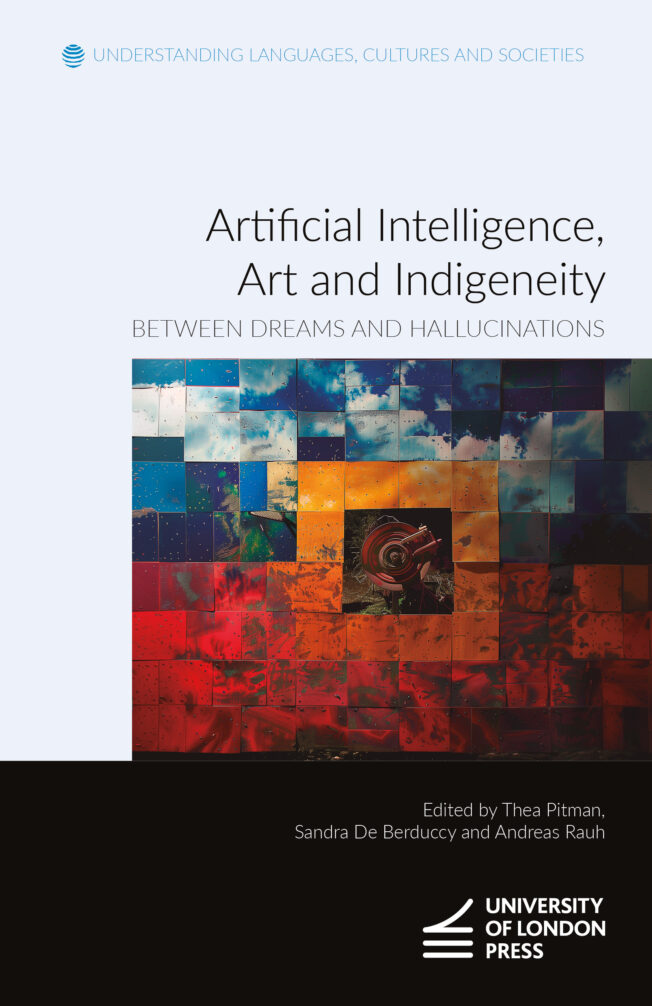

Artificial Intelligence, Art and Indigeneity
Between Dreams and Hallucinations
Thea Pitman (Editor), Sandra De Berduccy (Editor), Andreas Rauh (Editor)

Series: Understanding Languages, Cultures and Societies
Published in association with: Institute of Languages, Cultures and Societies
Artificial Intelligence, Art and Indigeneity explores the cultural and ethical implications of generative AI through the lens of Indigenous visual culture in Latin America. Responding to the rise of tools like DALL·E and Midjourney, this groundbreaking volume documents the AIAI project (2023–), which invited a group of Indigenous artists and writers from Argentina, Bolivia, Brazil, Chile and Peru to critically engage with image generation technologies. Through collaborative experimentation with a range of both commercial and bespoke tools, contributors reflect on the promises and pitfalls of AI—from its potential for ‘dreaming’, for imagining Indigenous futures, to the frustration of its ability to ‘hallucinate’, to distort and misrepresent Indigenous cultures.
Bringing together artists, writers, and scholars, the book challenges dominant narratives around AI and representation, using a decolonial framework rooted in Indigenous epistemologies. Structured in three parts – context and theory, creative reflections, and generative critique – it foregrounds multivocal and multilingual perspectives, resisting homogenisation and reframing participatory research. This is the first book-length study of generative AI’s impact on Indigenous visual culture in Latin America, making a timely and vital contribution to global debates on AI, art, and cultural sovereignty.
The chapters by the Indigenous artists and writers in the central section of this multilingual book are published in their original Spanish or Portuguese as well as in English translation. The book’s enhanced open access edition features Spanish- and Portuguese-language versions of the full text along with additional multimedia resources including video interviews with a number of the artists and a curated selection of images and animations.
The publication of this multilingual book was made possible with support from the University of London Publications Fund.
Artificial Intelligence, Art and Indigeneity deftly explores the tensions, contradictions and creative possibilities that arise when hegemonic AI technologies are reappropriated in the service of Indigenous and decolonial imaginaries. Creative in its methodology and writing, it is a valuable resource for scholars of Latin American visual culture, critical Indigenous studies and digital humanities methods.
—Sarah Abel, Assistant Professor in Philosophy of Science, Universidad Nacional Autónoma de México
A pioneering work grounded in Indigenous epistemologies. Through real-world experimentation, its authors—academics, artists, and activists—demonstrate that AI fails to grasp their cosmovisions, and that true inclusion requires more than adding data or refining prompts. A living archive of resistance, media appropriation, and indispensable decolonial and technological critique from Latin America.
Una obra pionera fundamentada en epistemologías indígenas. Mediante la experimentación real, los autores, quienes son académicos, artistas y activistas, demuestran que la IA no comprende sus cosmovisiones y que la verdadera inclusión no se logra ni añadiendo más datos ni refinando los prompts. Un archivo vivo de resistencia, apropiación mediática e indispensable crítica decolonial y tecnológica desde América Latina.
—Rubria Rocha de Luna, Profesora de cátedra, Tecnológico de Monterrey, Mexico
This book is compelling in its presentation of the challenges posed by generative Artificial Intelligence in relation to art, identity, and Indigenous epistemologies. I consider it especially important that the text advocates for Indigenous peoples to participate in the development of these technologies rather than being treated merely as objects of study.
This emphasis on Indigenous agency points towards what I see as the next crucial stage of research and development: creating knowledge bases produced by Indigenous people themselves. The Etnias social network was created with this purpose, bringing together a wide range of Indigenous-authored materials. At a time when much online information about Indigenous Peoples is shaped by non-Indigenous perspectives, initiatives such as Etnias can help ensure that future AI systems more accurately reflect the diversity and reality of Indigenous peoples.
A leitura desse livro me pareceu muito consistente ao apresentar os desafios da Inteligência Artificial generativa em relação à arte, à identidade e às epistemologias indígenas. Considero especialmente importante a defesa de que os povos indígenas participem da construção dessas tecnologias e não sejam apenas objetos de estudo.
Essa ênfase na agência indígena aponta para o que considero ser a próxima etapa fundamental da pesquisa e do desenvolvimento: a construção de bases de conhecimento produzidas por indígenas. A rede social Etnias foi criada com esse propósito, reunindo uma ampla variedade de materiais produzidos por autores indígenas. Em um contexto em que grande parte das informações disponíveis online sobre os Povos Indígenas é moldada por perspectivas não indígenas, iniciativas como a Etnias podem contribuir para que futuros sistemas de inteligência artificial reflitam de forma mais fiel a diversidade e a realidade dos povos indígenas.
— Karuãn Tenteneady, tecnólogo indígena desenvolvedor de sistemas e criador da rede social Etnias / Indigenous systems development technologist and creator of the social network Etnias (www.etnias.site), Brasil.
-
Introduction
- Part I AI, Art and Indigeneity
Thea Pitman -
1 AI and Art
-
2 Indigenous AI
-
3 Indigenous Art and AI
-
4 Indigenous Art and AI in a Latin American Context
-
5 A Timeline of AIAI
-
6 Methodology
-
Part II Between Dreams and Hallucinations
-
7 Autenticidad Creativa y Sensibilidad Visual Artificial/Creative Authenticity and Artificial Visual Sensibility
Nicolás Jiménez Reyes (Azul) -
8 Inteligencia Artificial o los Artificios de la Inteligencia/Artificial Intelligence or the Artifices of Intelligence
Lucio Torrez Soria (Lucian de Silenttio) -
9 Desde una Cuenta Propia hasta un Modelo Propio/From an Account of One’s Own to a Model of One’s Own
Haylly Zamora Aray -
10 A Inteligência Artificial e a cosmofloresta, e Representando os encantados e os parentes com IA / Artificial Intelligence and the Cosmoforest, and Representing Indigenous People and their Spirits with AI
Tadeu Dos Santos (Tadeu Kaingang / Ta No Kaingang) -
11 Hasta sueño con la IA/I Even Dream about AI
Mariela Tulián -
12 Nikiékliwahi e o Espírito da Máquina, e Realismo Digital Indigena/Nikiékliwahi and the Spirit of the Machine, and Indigenous Digital Realism
José Nunes de Oliveira (Nhenety Kariri-Xocó) -
Part III Generative Thoughts
-
13 A Genealogy of Stereotypes: The Representation of Indigenous Peoples with Generative AI
Sandra De Berduccy -
14 Drawing the Line: Creativity, Censorship and Copyright in Indigenous Engagement with AI Image-Generation Tools
Thea Pitman -
15 Dragon Dreaming: Notes on Methodology for Collaborative Design of an Indigenous Image-Generation Prototype
Dave Lynch and Sam Hallas -
16 Algorithmic Indigeneity, Indigenous Textiles and Future Imaginaries
Sandra de Berduccy -
17 Artificial Intelligence, Appropriation, Ancestrality and Buen Vivir Sebastián Gerlic and Alex Potiguara
-
18 Is It Art? Exhibiting the AIAI Project
Thea Pitman, Sandra De Berduccy and Andreas Rauh - Conclusion
Andreas Rauh
PDF: 9781807160036
EPUB: 9781807160043
Read Online: 9781807160029
Hardback: 9781807160005 / 250 pages / 220mm x 144mm
Paperback: 9781807160012 / 250 pages / 216mm x 140mm
Thea Pitman (Editor) 
Thea Pitman is Professor of Latin American Studies in the School of Languages, Cultures and Societies, University of Leeds. Her research focuses on Latin/x American digital cultural production, in particular Indigenous appropriations of digital technologies. Her publications include the co-edited anthology Latin American Cyberculture and Cyberliterature (LUP, 2007), and the monographs Latin American Identity in Online Cultural Production (Routledge, 2013) and Decolonising the Museum: The Curation of Indigenous Contemporary Art in Brazil (Tamesis, 2021).
Sandra De Berduccy (Editor)
Sandra De Berduccy, also known as aruma, is an artist, researcher, and specialist in Andean textile weaving. She is currently studying for a PhD in the Interdisciplinary Humanities Doctoral Programme at the Universidad Finis Terrae, Chile, and is a lecturer in the master’s program in Art and Technology at the Escuela Politécnica del Litoral, Ecuador. Her artistic research explores Andean textile practices and their relationship with new media art.
Andreas Rauh (Editor)
Andreas Rauh is Assistant Professor of Audio and Cultural Production in the School of Communications at Dublin City University. His research focuses on grassroots cultural production and digital technologies, particularly sonic design, music and the cultural industries, and generative AI, and has been published in a range of academic journals. He is also active as a musician and sound designer: projects include Sincronia Sonora (2019), with the Ymboré Indigenous community in Bahia, Brazil.
Artificial Intelligence, Art and Indigeneity deftly explores the tensions, contradictions and creative possibilities that arise when hegemonic AI technologies are reappropriated in the service of Indigenous and decolonial imaginaries. Creative in its methodology and writing, it is a valuable resource for scholars of Latin American visual culture, critical Indigenous studies and digital humanities methods.
—Sarah Abel, Assistant Professor in Philosophy of Science, Universidad Nacional Autónoma de México
A pioneering work grounded in Indigenous epistemologies. Through real-world experimentation, its authors—academics, artists, and activists—demonstrate that AI fails to grasp their cosmovisions, and that true inclusion requires more than adding data or refining prompts. A living archive of resistance, media appropriation, and indispensable decolonial and technological critique from Latin America.
Una obra pionera fundamentada en epistemologías indígenas. Mediante la experimentación real, los autores, quienes son académicos, artistas y activistas, demuestran que la IA no comprende sus cosmovisiones y que la verdadera inclusión no se logra ni añadiendo más datos ni refinando los prompts. Un archivo vivo de resistencia, apropiación mediática e indispensable crítica decolonial y tecnológica desde América Latina.
—Rubria Rocha de Luna, Profesora de cátedra, Tecnológico de Monterrey, Mexico
This book is compelling in its presentation of the challenges posed by generative Artificial Intelligence in relation to art, identity, and Indigenous epistemologies. I consider it especially important that the text advocates for Indigenous peoples to participate in the development of these technologies rather than being treated merely as objects of study.
This emphasis on Indigenous agency points towards what I see as the next crucial stage of research and development: creating knowledge bases produced by Indigenous people themselves. The Etnias social network was created with this purpose, bringing together a wide range of Indigenous-authored materials. At a time when much online information about Indigenous Peoples is shaped by non-Indigenous perspectives, initiatives such as Etnias can help ensure that future AI systems more accurately reflect the diversity and reality of Indigenous peoples.
A leitura desse livro me pareceu muito consistente ao apresentar os desafios da Inteligência Artificial generativa em relação à arte, à identidade e às epistemologias indígenas. Considero especialmente importante a defesa de que os povos indígenas participem da construção dessas tecnologias e não sejam apenas objetos de estudo.
Essa ênfase na agência indígena aponta para o que considero ser a próxima etapa fundamental da pesquisa e do desenvolvimento: a construção de bases de conhecimento produzidas por indígenas. A rede social Etnias foi criada com esse propósito, reunindo uma ampla variedade de materiais produzidos por autores indígenas. Em um contexto em que grande parte das informações disponíveis online sobre os Povos Indígenas é moldada por perspectivas não indígenas, iniciativas como a Etnias podem contribuir para que futuros sistemas de inteligência artificial reflitam de forma mais fiel a diversidade e a realidade dos povos indígenas.
— Karuãn Tenteneady, tecnólogo indígena desenvolvedor de sistemas e criador da rede social Etnias / Indigenous systems development technologist and creator of the social network Etnias (www.etnias.site), Brasil.
Subject: Languages, Cultures and Societies, Latin American and Caribbean Studies
BISAC codes: ART041000, COM100000, SOC008050, SOC062000
Thema codes: ABA, JBF, UYQ
Keywords: decolonial, futurism, indigenous art, indigenous peoples, latin america, representation, self-expression, technology, traditional art, visual culture
EPUB accessibility:
Accessibility summary
EPUB Accessibility Specification 1.1
Table of contents navigation
Index navigation
Single logical reading order
Short alternative textual descriptions
Print-equivalent page numbering
Use of color is not sole means of conveying information
Next / Previous structural navigation
ARIA roles provided
Appearance of all textual content can be modified
All non-decorative content supports reading without sight
WCAG v2.2
WCAG level AA
Compliance certification by (name)
More books in this subject area

Postcards, Translators and Esperanto Pioneers
Guilherme Fians
Bernhard Struck
Claire Taylor
13 November 2025

Liberation Theology and Praxis in Contemporary Latin America
Pablo Bradbury
Niall H.D. Geraghty
20 February 2025
More-Than-Human Histories of Latin America and the Caribbean
Diogo de Carvalho Cabral
André Vasques Vital
Margarita Gascón
25 July 2024

The Social and Political Life of Latin American Infrastructures
Jonathan Alderman
Geoff Goodwin
5 October 2022

Opposing Patriarchy: Women and the Law in Action in Pre-Unification Italy (1815-1865)
Sara Delmedico
15 November 2021