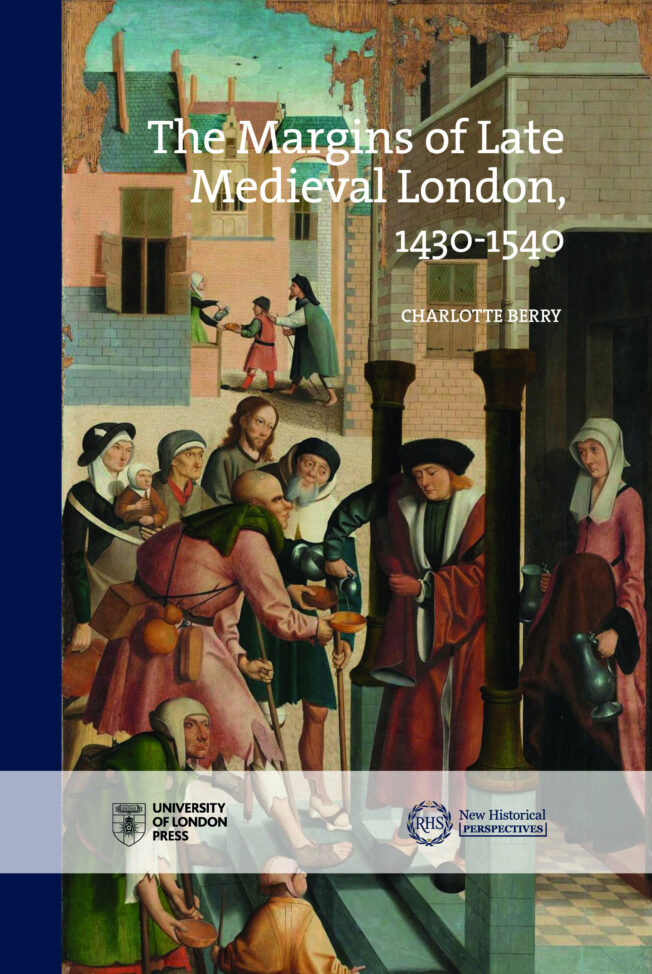

The Margins of Late Medieval London, 1430-1540
Charlotte Berry (Author)

Series: New Historical Perspectives
Published in association with: Institute of Historical Research, Royal Historical Society
The Margins of Late Medieval London is a powerful study of medieval London’s urban fringe. Seeking to unpack the complexity of urban life in the medieval age, this volume offers a detailed and novel approach to understanding London beyond its institutional structures. Using a combination of experimental digital, quantitative and qualitative methodologies, the volume casts new light on urban life at the level of the neighbourhood and considers the differences in economy, society and sociability which existed in different areas of a vibrant premodern city. It focuses on the dynamism and mobility that shaped city life, integrating the experiences of London’s poor and migrant communities and how they found their place within urban life. It describes how people found themselves marginalized in the city, and the strategies they would employ to mitigate that precarious position.
The Margins of Late Medieval London is an excellent fit for the Royal Historical Society’s New Perspectives series since it introduces exciting new research on an underexplored area: London’s extramural neighborhoods. Charlotte Berry should be given credit for opening up a difficult area of research and deploying new techniques of data analysis. …One of the many strengths of this book is a consistent attention to the lives of women,immigrants, and the poor. Women are not confined to a stand-alone chapter but are instead integral to the analysis throughout the book. Close reading of the sources, particularly the wardmote cases, provides fascinating insights into ways in which people negotiated relations with their neighbors. Berry presents her impressive amount of data in clear, well-presented graphs, diagrams, and tables.
—Helen Lacey, Mansfield College, Oxford, UK.
Speculum: A Journal of Medieval Studies
The Margins of Late Medieval London is a significant intervention in the historiography of pre-modern towns and cities. … The cultural approaches taken to this traditional question of social history will undoubtedly be of great interest to those working on other contexts.
—Justin Colson, Institute of Historical Research, University of London, UK
Continuity and Change
Introduction Chapter One: Landscape and economy Chapter Two: Socio-spatial networks Chapter Three: Mobility Chapter Four: Controlling inclusion and exclusion Chapter Five: Reputation, marginalisation and space Conclusion Bibliography
PDF: 9781914477034
EPUB: 9781914477041
Read Online: 9781911507444
Hardback: 9781914477010 / 245mm x 163mm
Paperback: 9781914477027 / 156mm x 234mm
Charlotte Berry (Author)
Charlotte Berry is an independent scholar and completed her PhD at the Institute of Historical Research, University of London. She has held teaching and research positions at Bath Spa University, Roehampton University and University College London. She has previously published work on marginality, reputation, sociability and immigration in late medieval society, in publications including The Journal of British Studies and London Journal.
The Margins of Late Medieval London is an excellent fit for the Royal Historical Society’s New Perspectives series since it introduces exciting new research on an underexplored area: London’s extramural neighborhoods. Charlotte Berry should be given credit for opening up a difficult area of research and deploying new techniques of data analysis. …One of the many strengths of this book is a consistent attention to the lives of women,immigrants, and the poor. Women are not confined to a stand-alone chapter but are instead integral to the analysis throughout the book. Close reading of the sources, particularly the wardmote cases, provides fascinating insights into ways in which people negotiated relations with their neighbors. Berry presents her impressive amount of data in clear, well-presented graphs, diagrams, and tables.
—Helen Lacey, Mansfield College, Oxford, UK.
Speculum: A Journal of Medieval Studies
The Margins of Late Medieval London is a significant intervention in the historiography of pre-modern towns and cities. … The cultural approaches taken to this traditional question of social history will undoubtedly be of great interest to those working on other contexts.
—Justin Colson, Institute of Historical Research, University of London, UK
Continuity and Change
Subject: History, Medieval History
BISAC codes: ARC010000, HIS015000, HIS015020, POL002000, SOC045000
Thema codes: JBFC, JBSD, KCVS, NHDJ, RGCU
Keywords: London, London poor, begging, capital city, countryside, disease, labour, marginality, medieval London, middle ages, migrant, migration, poverty, prostitution, refugees, sewage, workers
More books in this subject area

Living with Machines
Ruth Ahnert
Emma Griffin
Jon Lawrence
The Living with Machines Team
12 November 2026

Fasti Ecclesiae Anglicanae 1541–1857: The Welsh Dioceses XIV
William H. Campbell
Joyce M. Horn
13 August 2026
Postcards, Translators and Esperanto Pioneers
Guilherme Fians
Bernhard Struck
Claire Taylor
13 November 2025

Atlantic Isles: Travel and Identity in the British and Irish West, 1880–1940
Gareth Roddy
30 October 2025