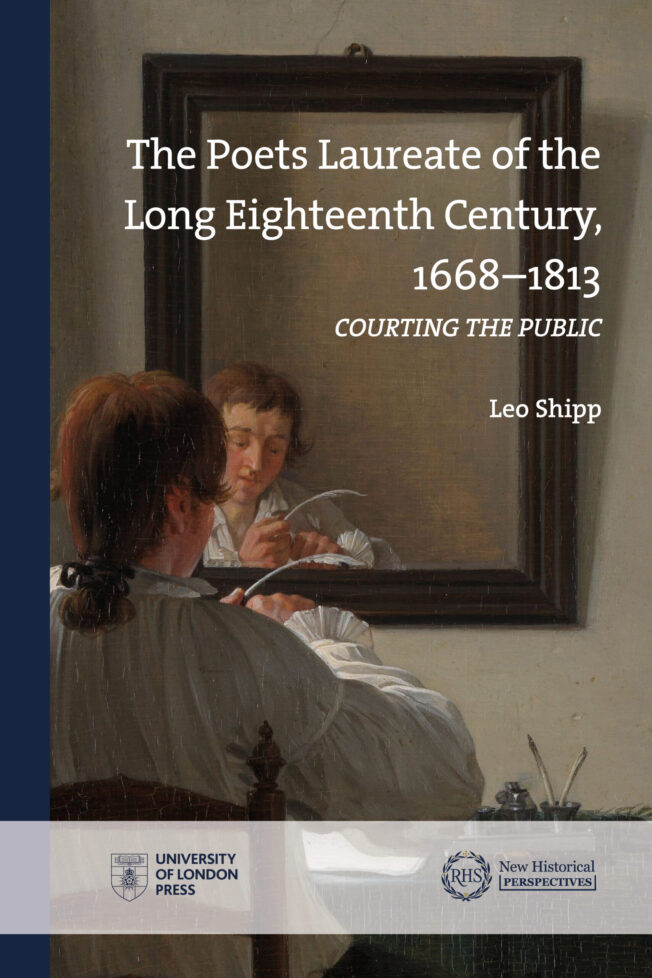

The Poets Laureate of the Long Eighteenth Century, 1668–1813
Courting the Public
Leo Shipp (Author)

Series: New Historical Perspectives
Published in association with: Institute of Historical Research, Royal Historical Society
The office of the poet laureate of Britain was a highly prominent, relevant and respectable institution throughout the long eighteenth century. First instituted for John Dryden in 1668, the laureateship developed from an honorific into a functionary office with a settled position in court (c.1689–1715), and was bestowed upon Robert Southey in 1813, whose tenure eventually transformed the office. Taking an interdisciplinary approach, this book examines the office’s institutional changes and public reception, the mechanics of each laureate’s appointment, and the works produced by the laureates before and after their appointments. It argues that the laureateship played a key part in some of the most vital trends in eighteenth-century culture.
The conclusion is arrived at by employing a new research paradigm that it calls the conceptual geography of culture. It shows that Britons routinely used spatial concepts to understand culture throughout the period, which became increasingly abstract over time. As part of this, the court evolved from a concrete space in London to an abstract space capable of hosting the entire British public. The laureateship was a dynamic office positioned at the interface of court and public, evolving in line with its audiences. An important intervention in eighteenth-century historiography, this book presents a nuanced understanding of eighteenth-century culture and society, in which the laureateship exemplified the enduring centrality of the court to the British conceptual geography of culture.
an overdue corrective … demonstrating that the eighteenth-century laureateship was not only an important office, but was well integrated into wider trends in eighteenth-century culture … Shipp’s book should be praised for its deft handling of diverse historical and literary sources, from financial accounts to panegyric forms, and for its style, especially its humour. The book’s primary significance lies in the idea of ‘conceptual geography’, which establishes a promising framework for research beyond the subject of the laureateship.
— Edward Taylor, University of Birmingham, Birmingham, UK
History: The Journal of the Historical Association
Leo Shipp’s monograph is the first analytical study of the office of poet laureate to be published since E. K. Broadus’s The Laureateship in 1921. … Shipp’s study interrogatively remaps the imagined landscapes of literary production and consumption and national identity in Britin – especially, though this is not drawn upon, in England – and as a study of the office of poet laureate … is indispensable.
— Matthew Kilburn, Independent scholar, UK
Culture and Social History
This book represents not only a remarkable achievement of synthesis of different source bases, but real thoughtfulness about the relationship between the person(s) on whose behalf the poet laureate wrote, those to whom they wrote, and the public, allowed to follow along … Shipp deserves our collective gratitude in proportion to that magnitude for this measured, thorough, and capacious work.
—Claude Willan, Associate Professor, Associate Professor in the Department of English Studies, Durham University, UK
Eighteenth-Century Studies
Introduction. 1. Patronage Asserted: The Formation of the Laureateship, 1668–1715 2. Loyalty Marketed: The Works of the Early Hanoverian Laureates, c.1700–1730 3. Merit Rewarded: The Hanoverian Appointments, 1715–1813 4. Parnassus Reported: The Public Laureate, c.1757–1813 5. “But Odes of S—– almost choakt the way”: Laureate Writings of the Long Eighteenth Century Conclusion.
PDF: 9781914477324
EPUB: 9781914477331
Read Online: 9781913002091
Hardback: 9781914477294 / 245mm x 163mm
Paperback: 9781914477300 / 156mm x 234mm
Leo Shipp (Author)
Leo Shipp is a postdoctoral researcher at the University of Galway, working on Professor David O'Shaughnessy's ERC-funded project, 'Theatronomics: The Business of Theatres, 1732-1809', researching the finances of eighteenth-century Drury Lane and Covent Garden. He teaches on the early modern period and the long eighteenth century in University of Galway's History department.
an overdue corrective … demonstrating that the eighteenth-century laureateship was not only an important office, but was well integrated into wider trends in eighteenth-century culture … Shipp’s book should be praised for its deft handling of diverse historical and literary sources, from financial accounts to panegyric forms, and for its style, especially its humour. The book’s primary significance lies in the idea of ‘conceptual geography’, which establishes a promising framework for research beyond the subject of the laureateship.
— Edward Taylor, University of Birmingham, Birmingham, UK
History: The Journal of the Historical Association
Leo Shipp’s monograph is the first analytical study of the office of poet laureate to be published since E. K. Broadus’s The Laureateship in 1921. … Shipp’s study interrogatively remaps the imagined landscapes of literary production and consumption and national identity in Britin – especially, though this is not drawn upon, in England – and as a study of the office of poet laureate … is indispensable.
— Matthew Kilburn, Independent scholar, UK
Culture and Social History
This book represents not only a remarkable achievement of synthesis of different source bases, but real thoughtfulness about the relationship between the person(s) on whose behalf the poet laureate wrote, those to whom they wrote, and the public, allowed to follow along … Shipp deserves our collective gratitude in proportion to that magnitude for this measured, thorough, and capacious work.
—Claude Willan, Associate Professor, Associate Professor in the Department of English Studies, Durham University, UK
Eighteenth-Century Studies
Subject: History, Literary Studies, Social and Cultural History
BISAC codes: HIS015050, LAN005070
Thema codes: DSC, NHTB
Keywords: court, culture, eighteenth century, poet laureate, poetry, public reception, spatiality
EPUB accessibility:
Accessibility summary
EPUB Accessibility Specification 1.1
Table of contents navigation
Index navigation
Single logical reading order
Short alternative textual descriptions
Print-equivalent page numbering
Use of color is not sole means of conveying information
Next / Previous structural navigation
ARIA roles provided
Appearance of all textual content can be modified
All non-decorative content supports reading without sight
WCAG v2.2
WCAG level AA
Compliance certification by (name)
More books in this subject area


Living with Machines
Ruth Ahnert
Emma Griffin
Jon Lawrence
The Living with Machines Team
12 November 2026

Fasti Ecclesiae Anglicanae 1541–1857: The Welsh Dioceses XIV
William H. Campbell
Joyce M. Horn
13 August 2026

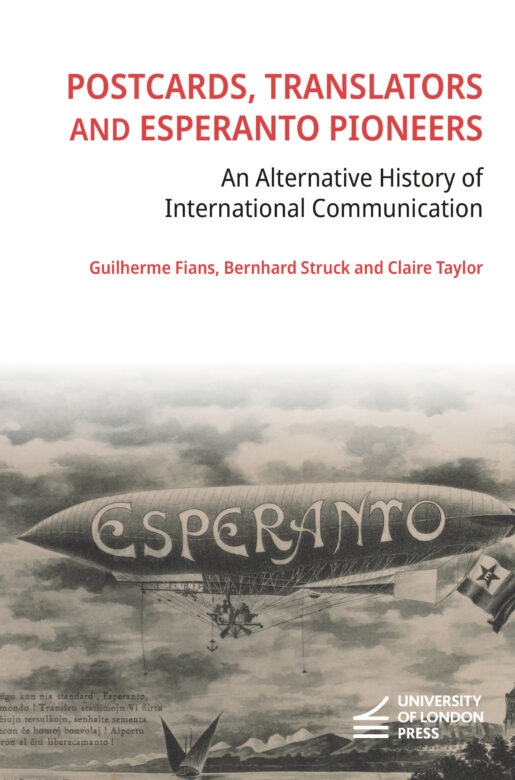
Postcards, Translators and Esperanto Pioneers
Guilherme Fians
Bernhard Struck
Claire Taylor
13 November 2025