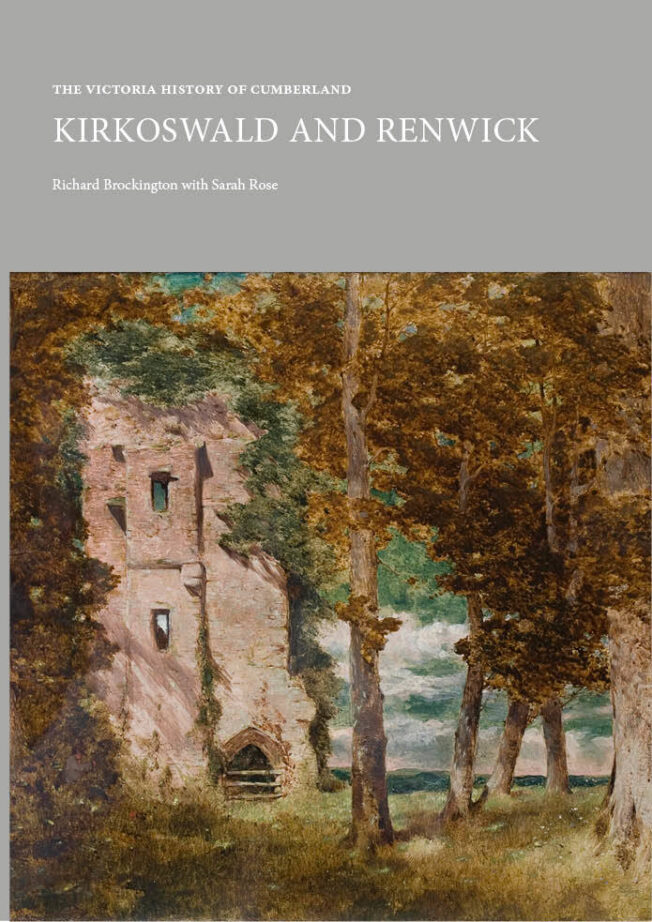
Victoria County History of Cumbria: Kirkoswald and Renwick
Richard Brockington (Author), Sarah Rose (Author)
Series: VCH Shorts
Published in association with: Institute of Historical Research
Kirkoswald and Renwick is the first parish history to be produced by the Cumbria County History Trust in collaboration with Lancaster University for the Victoria County History of Cumbria. Covering 30 square miles of agricultural land and moorland, the modern civil parish of Kirkoswald lies between the river Eden and the Pennine heights, on the western edge of the North Pennine Area of Outstanding Natural Beauty. Kirkoswald township, anciently a market and small industrial centre, lies nine miles north east of Penrith. Until 1566 Kirkoswald Castle was the principal seat of the powerful Barons Dacre of the North whose massive landholdings extended over six counties. In 1523 Lord Thomas Dacre translated St Oswald’s church, a pre-conquest foundation for which the village is named, to collegiate status, and after the Reformation the college became a gentleman’s residence, acquired in 1611 by the Fetherstonhaugh family whose home it still is after 400 years and 11 generations of descent.
The economy, largely dependent on agriculture, benefited for 600 years from Kirkoswald’s role as a market and business centre, with some manufacturing (textiles, paper and timber) powered by the waters of the Raven Beck. From 1631 to about 1850 there was coal mining on the Pennine Edge (with associated lime-burning). In the 21st century the parish remains an unspoilt and beautiful corner of England, home to some 30 farms specialising in animal husbandry, and many retired people and commuters to Penrith and Carlisle.
It is very difficult to find fault with this excellent new local history. The production quality is outstanding,including numerous photos and maps as well as a first-rate glossary. It is a stand-alone study that is illuminating in its own right, valuable to anyone with an interest in upland communities.
Landscape History
It takes considerable effort to find fault. The book is thorough, detailed and yet concise, well laid out and even manages to find room for an index and glossary. The authors deserve great credit in setting such a high standard for subsequent volumes of the VCH for Cumbria, and if all of the subsequent ones are of this quality, they will form an extremely valuable resource and do great service to the project as a whole.
Northern History
Introduction
1. Landownership
2. Economic history
3. Social history
4. Religious history
5. Local government
EPUB: 9781912702053
Paperback: 9781912702046 / 254mm x 178mm
Richard Brockington (Author)
Sarah Rose (Author)
It is very difficult to find fault with this excellent new local history. The production quality is outstanding,including numerous photos and maps as well as a first-rate glossary. It is a stand-alone study that is illuminating in its own right, valuable to anyone with an interest in upland communities.
Landscape History
It takes considerable effort to find fault. The book is thorough, detailed and yet concise, well laid out and even manages to find room for an index and glossary. The authors deserve great credit in setting such a high standard for subsequent volumes of the VCH for Cumbria, and if all of the subsequent ones are of this quality, they will form an extremely valuable resource and do great service to the project as a whole.
Northern History
Subject: History, Local History
BISAC codes: HIS015000, SOC015000, SOC053000
Thema codes: NHD, NHTB, RGL, WQH
Keywords: Cumbria, Economic history, England, development, local history
More books in this subject area

Living with Machines
Ruth Ahnert
Emma Griffin
Jon Lawrence
The Living with Machines Team
12 November 2026

Fasti Ecclesiae Anglicanae 1541–1857: The Welsh Dioceses XIV
William H. Campbell
Joyce M. Horn
13 August 2026
Postcards, Translators and Esperanto Pioneers
Guilherme Fians
Bernhard Struck
Claire Taylor
13 November 2025
Atlantic Isles: Travel and Identity in the British and Irish West, 1880–1940
Gareth Roddy
30 October 2025