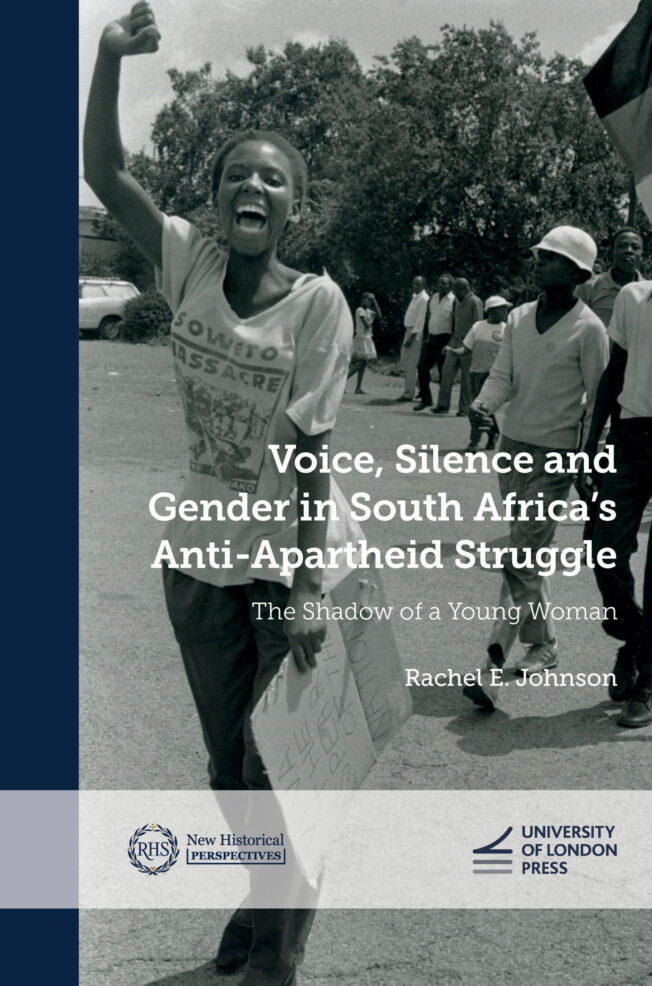

Voice, Silence and Gender in South Africa’s Anti-Apartheid Struggle
The Shadow of a Young Woman
Rachel E. Johnson (Author)

Series: New Historical Perspectives
Published in association with: Institute of Historical Research, Royal Historical Society
Open Access publication funded by Jisc Open Access Community Framework
In 1978, amidst the aftermath of the Soweto Uprisings and after being held in detention without charge for over a year, a young black woman who had just turned eighteen, stepped into the witness box at Kempton Park Circuit Court, north-east of Johannesburg. She was there to testify in the apartheid State’s case against eleven Soweto school student activists, on trial for sedition. She confirmed her name as Mary Masabata Loate. Loate would live with the consequences of this decision to talk for the rest of her short life.
Who spoke about the liberation struggle whilst it was ongoing? When did they speak and how? And what effects does the gendered history of speech and silence within anti-apartheid politics continue to have upon our knowledge of the past? Arguing that she is emblematic of the way gendered narratives of the struggle have been made, this book listens for the voice and silence of Masabata Loate and her contemporaries within political trials; newspapers; photography; human rights reportage; creative fiction, drama, poetry and song; autobiography and memoir; and oral histories. The result is an unconventional biography that sees this young woman as a shadow within the story of South Africa’s anti-apartheid liberation struggle.
Through the lens of the controversial life of Mary Masabata Loate, a witness for the prosecution at the trial of the ‘Soweto Eleven’ in 1978, Rachel E. Johnson’s book provides an important contribution to our understanding of how gender complicated and compromised the way young black women were forced to navigate their relationship to the Anti-Apartheid struggle. Historically attentive, this book also invites the reader to question what kinds of truths might be delivered from an archive which too often occludes the role in the Anti-Apartheid struggle of South Africa’s youth and young black women in particular.
—Annie E. Coombes, Professor Emerita of Material and Visual Culture, Birkbeck, University of London UK. Author of History After Apartheid: Visual Culture and Public Memory in a Democratic South Africa (2003)
As with many excellent books, this study provides ideas and methods that can be transferred to situations beyond the scholarly bounds of recent South African history. As I read the book I kept asking, and seeing, how the ideas on voice and silence might be applied to my topics of research on the black Atlantic world and to English local and regional history.
—David Killingray, School of Advanced Study, University of London, UK
FAMILY & COMMUNITY HISTORY
-
Introduction: The Shadow of a Young Woman
-
1 A Methodology for Fragments: Voice, Speech, and Silence
-
2 The Soweto Eleven and the Sayable: Speaking about the Struggle
-
3 Witnessing, Detention, and Silence: Speech as Struggle
-
4 Stories of Life and Death: the Struggle to Speak
-
Conclusion: Shadow Histories
PDF: 9781915249463
EPUB: 9781915249470
Read Online: 9781915249999
Hardback: 9781915249449 / 188 pages / 240mm x 160mm
Paperback: 9781915249456 / 188 pages / 234mm x 156mm
Rachel E. Johnson (Author)
Rachel E. Johnson is a historian of South Africa with interests in gender and politics. She is Assistant Professor in Modern African History at Durham University.
Through the lens of the controversial life of Mary Masabata Loate, a witness for the prosecution at the trial of the ‘Soweto Eleven’ in 1978, Rachel E. Johnson’s book provides an important contribution to our understanding of how gender complicated and compromised the way young black women were forced to navigate their relationship to the Anti-Apartheid struggle. Historically attentive, this book also invites the reader to question what kinds of truths might be delivered from an archive which too often occludes the role in the Anti-Apartheid struggle of South Africa’s youth and young black women in particular.
—Annie E. Coombes, Professor Emerita of Material and Visual Culture, Birkbeck, University of London UK. Author of History After Apartheid: Visual Culture and Public Memory in a Democratic South Africa (2003)
As with many excellent books, this study provides ideas and methods that can be transferred to situations beyond the scholarly bounds of recent South African history. As I read the book I kept asking, and seeing, how the ideas on voice and silence might be applied to my topics of research on the black Atlantic world and to English local and regional history.
—David Killingray, School of Advanced Study, University of London, UK
FAMILY & COMMUNITY HISTORY
Subject: History, Political History
BISAC codes: BIO032000, HIS047000, POL052000, SOC032000
Thema codes: DNBH, JBSF1, NHH
Keywords: Masabata Loate, South Africa, Soweto Uprisings, activists, anti-apartheid, archives, black women, gender dynamics, history, human rights, liberation, political action, politics, silence, speech, struggle, women, women's rights, youth activism
EPUB accessibility:
Accessibility summary
EPUB Accessibility Specification 1.1
Table of contents navigation
Index navigation
Single logical reading order
Short alternative textual descriptions
Print-equivalent page numbering
Use of color is not sole means of conveying information
Next / Previous structural navigation
ARIA roles provided
Appearance of all textual content can be modified
All non-decorative content supports reading without sight
WCAG v2.2
WCAG level AA
Compliance certification by (name)
More books in this subject area

Living with Machines
Ruth Ahnert
Emma Griffin
Jon Lawrence
The Living with Machines Team
12 November 2026

Fasti Ecclesiae Anglicanae 1541–1857: The Welsh Dioceses XIV
William H. Campbell
Joyce M. Horn
13 August 2026
Postcards, Translators and Esperanto Pioneers
Guilherme Fians
Bernhard Struck
Claire Taylor
13 November 2025
Atlantic Isles: Travel and Identity in the British and Irish West, 1880–1940
Gareth Roddy
30 October 2025