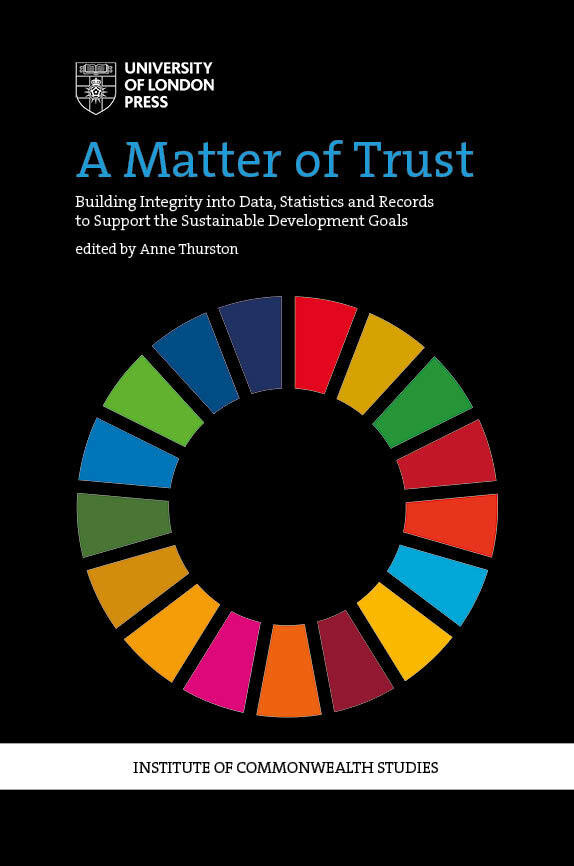

A Matter of Trust
Building Integrity into Data, Statistics and Records to Support the Achievement of the Sustainable Development Goals
Anne Thurston (Editor)

Published in association with: Institute of Commonwealth Studies
Open Access publication funded by Knowledge Unlatched
Research made possible by AHRC
The United Nations Sustainable Development Goals initiative has the potential to set the direction for a future world that works for everyone. Approved by 193 United Nations member countries in September 2016 to help guide global and national development policies in the period to 2030, the 17 goals build on the successes of the Millennium Development Goals, but also include new priority areas, such as climate change, economic inequality, innovation, sustainable consumption, peace and justice. Assessed against common agreed targets and indicators, the goals should facilitate inter-governmental cooperation and the development of regional and even global development strategies.
However, each goal presents considerable challenges in terms of collecting and analysing relevant data and producing the statistics needed to measure progress. Most governments in lower resourced countries simply do not yet have the systems and controls in place to produce high quality, reliable data and statistics, and it is questionable whether the quality and integrity of the available information is adequate to support meaningful decisions and set direction for the future.
There are substantial implications: where progress cannot be measured accurately because of inadequate or flawed statistics, the result can be misguided decisions, doubts about achievement of the goals and significant wasted resources. Getting statistics ‘right’ depends upon the quality and integrity of the data used to produce them and on the quality of the processes for collecting, manipulating and analysing the data. Without a documentary records as evidence of how the data were gathered and analysed or how statistics were produced and disseminated, it is not possible to confirm that the statistics are complete, accurate and relevant.
Various global organisations do recognise the importance of high quality data and statistics for measuring the SDG indicators reliably, but there has been little attention to the role of records in providing the evidence needed to trust the data and statistics. There is, moreover, a lack of awareness that digital information simply will not survive without policies and procedures to manage and preserve it through time. As a result, digital data, statistics and records are being lost regularly on a large scale, particularly in lower resource countries, where the structures needed to protect and preserve them are not yet in place.
This book explores, through a series of case studies, the substantial challenges for assembling reliable data and statistics to address pressing development challenges, particularly in Africa. Hopefully, by highlighting the enormous potential value of creating and using high quality data, statistics and records as an interconnected resource and describing how this can be achieved, the book will contribute to defining meaningful and realistic global and national development policies in the critical period to 2030.
1. Records as evidence for measuring sustainable development in Africa
Anne Thurston
2. The state of data and statistics in sub-Saharan Africa in the context of the Sustainable Development Goals
Paul Komba and Ngianga-Bakwin Kandala
3. Data, information and records: exploring definitions and relationships
Geoffrey Yeo interviewed by James Lowry
4. The potential – constructive and destructive – of information technology for records management: case studies from India
James Manor
5. Statistical accuracy and reliable records: a case study of mortality statistics in The Gambia
Andrew Griffin
6. Mainstreaming records and data management in sustainable development: lessons from the public and private sectors in Kenya
Justus Wamukoya and Cleophas Ambira
7. Open data and records management – activating public engagement to improve information: case studies from Sierra Leone and Cambodia
Katherine Townsend, Tamba Lamin, Amadu Massally and Pyrou Chung
8. Assuring authenticity in public sector data: a case study of the Kenya Open Data Initiative
James Lowry
9. Preserving the digital evidence base for measuring the Sustainable Development Goals
Adrian Brown
10. Preserving and using digitally encoded information as a foundation for achieving the Sustainable Development Goals
David Giaretta
11. Transparency in the 21st century: the role of records in achieving public access to information, protecting fundamental freedoms and monitoring sustainable development
Victoria Lemieux
12. Information management for international development: roles, responsibilities and competencies
Elizabeth Shepherd and Julie McLeod
13. The quality of data, statistics and records used to measure progress towards achieving the SDGs: a fictional situation analysis
John McDonald
PDF: 9781912250356
EPUB: 9781912250431
Read Online: 9781911507475
Paperback: 9781912250349 / 229mm x 152mm
Anne Thurston (Editor)
Subject: Commonwealth Studies, Human Rights
BISAC codes: COM021030, SOC042000
Thema codes: GTP, KCM
Keywords: United Nations, corruption, data, data collection, humanitarian work, infographics, statistics
EPUB accessibility:
Accessibility summary
EPUB Accessibility Specification 1.1
Table of contents navigation
Index navigation
Single logical reading order
Short alternative textual descriptions
Full alternative textual descriptions
Print-equivalent page numbering
Use of color is not sole means of conveying information
Next / Previous structural navigation
ARIA roles provided
Appearance of all textual content can be modified
All non-decorative content supports reading without sight
WCAG v2.2
WCAG level AA
Compliance certification by (name)
More books in this subject area
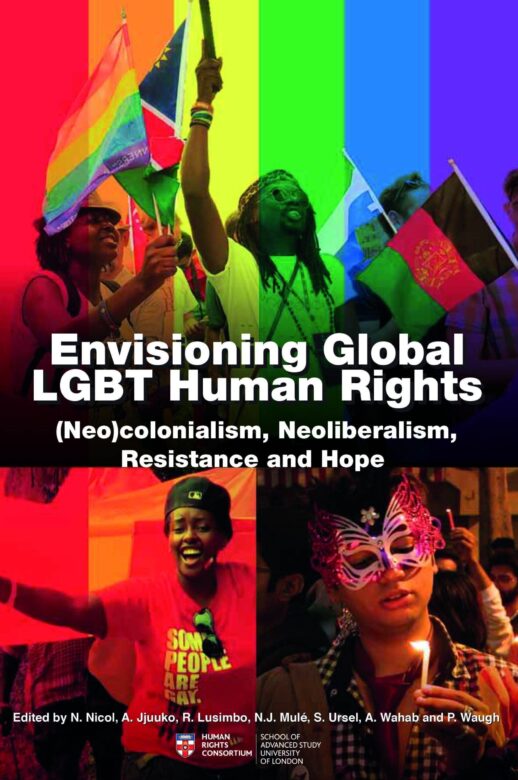
Envisioning Global LGBT Human Rights
Nancy Nicol
Adrian Jjuuko
Richard Lusimbo
Nick Mulé
Susan Ursel
Amar Wahab
Phyllis Waugh
13 September 2018

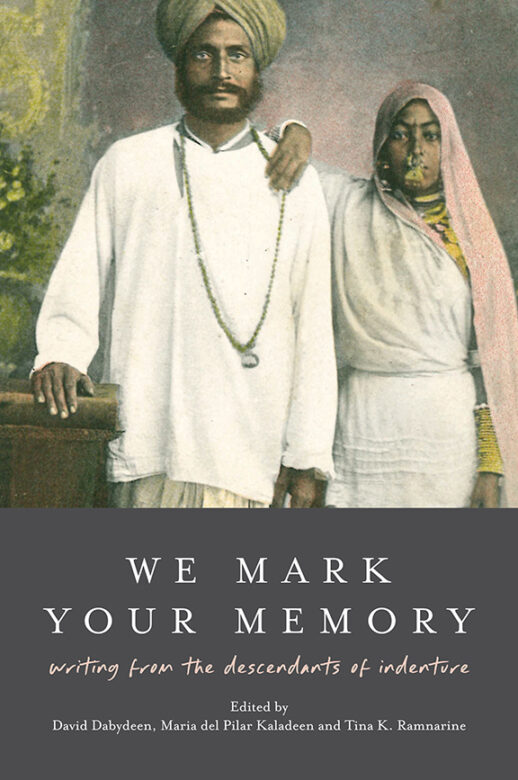
We Mark Your Memory: writings from the descendants of indenture
David Dabydeen
Maria del Pilar Kaladeen
Tina K. Ramnarine
30 April 2018