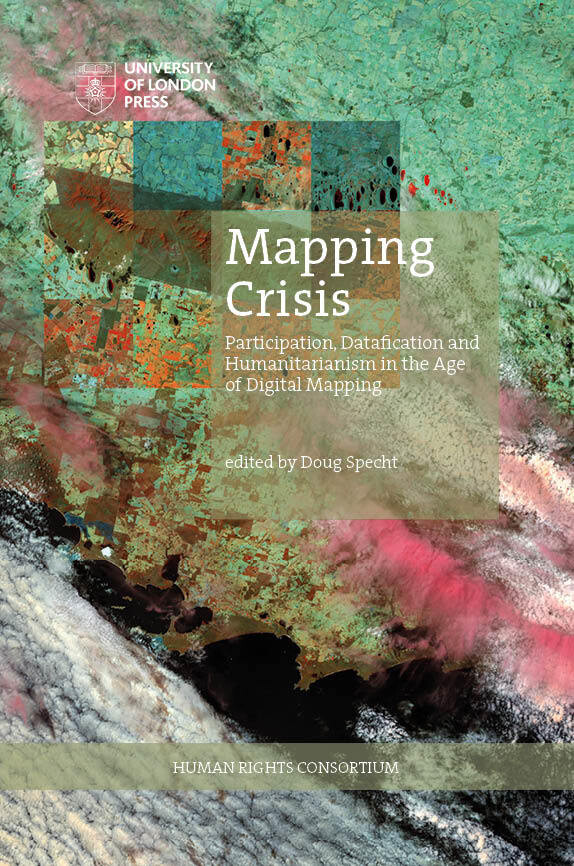

Mapping Crisis
Participation, Datafication and Humanitarianism in the Age of Digital Mapping
Doug Specht (Editor)

Series: Critical Human Rights Studies
Published in association with: Institute of Commonwealth Studies
Open Access publication funded by Knowledge Unlatched
The digital age has thrown questions of representation, participation and humanitarianism back to the fore, as machine learning, algorithms and big data centres take over the process of mapping the subjugated and subaltern. Since the rise of Google Earth in 2005, there has been an explosion in the use of mapping tools to quantify and assess the needs of those in crisis, including those affected by climate change and the wider neo-liberal agenda. Yet, while there has been a huge upsurge in the data produced around these issues, the representation of people remains questionable. Some have argued that representation has diminished in humanitarian crises as people are increasingly reduced to data points. In turn, this data has become ever more difficult to analyse without vast computing power, leading to a dependency on the old colonial powers to refine the data collected from people in crisis, before selling it back to them.
This book brings together critical perspectives on the role that mapping people, knowledges and data now plays in humanitarian work, both in cartographic terms and through data visualisations, and questions whether, as we map crises, it is the map itself that is in crisis.
Mapping Crisis: a reflection on the Covid-19 pandemic
Doug Specht
Introduction: mapping in times of crisis
Doug Specht
1. Mapping as tacit representations of the colonial gaze
Tamara Bellone, Salvatore Engel-di-Mauro, Francesco Fiermonte, Emiliana Armano and Linda Quiquivix
2. The failures of participatory mapping: a mediational perspective
Gregory Asmolov
3. Knowledge and spatial production between old and new representation: a conceptual and operative framework
M. Rosaria Prisco
4. Data colonialism, surveillance capitalism and drones
Faine Greenwood
5. The role of data collection, mapping and analysis in the reproduction of refugeeness and migration discourses: reflections from the Refugee Spaces project
Giovanna Astolfo, Ricardo Marten Caceres, Falli Palaiologou, Camillo Boano and Ed Manley
6. Dying in the technosphere: an intersectional analysis of European migration maps
Monika Halkort
7. Now the totality maps us: mapping climate migration and surveilling movable borders in digital cartographies
Bogna M Konior
8. The rise of the citizen data scientist
Aleš Završnik and Pika Šarf
9. Modalities of united statelessness
Rupert Allan
PDF: 9781912250387
EPUB: 9781912250370
Read Online: 9781912250561
Paperback: 9781912250332 / 276 pages / 229mm x 152mm
Doug Specht (Editor)
Subject: Human Rights
BISAC codes: SOC015000, SOC066000, TEC048000
Thema codes: JBFG, NHTQ, RGV
Keywords: cartography, crisis, data, humanitarian work, mapping, maps
EPUB accessibility:
Accessibility summary
EPUB Accessibility Specification 1.1
Table of contents navigation
Index navigation
Single logical reading order
Short alternative textual descriptions
Full alternative textual descriptions
Print-equivalent page numbering
Use of color is not sole means of conveying information
Next / Previous structural navigation
ARIA roles provided
Appearance of all textual content can be modified
All non-decorative content supports reading without sight
WCAG v2.2
WCAG level AA
Compliance certification by (name)
More books in this subject area



Envisioning Global LGBT Human Rights
Nancy Nicol
Adrian Jjuuko
Richard Lusimbo
Nick Mulé
Susan Ursel
Amar Wahab
Phyllis Waugh
13 September 2018



In Protest: 150 Poems for Human Rights
Helle Abelvik-Lawson
Anthony Hett
Laila Sumpton
1 October 2013