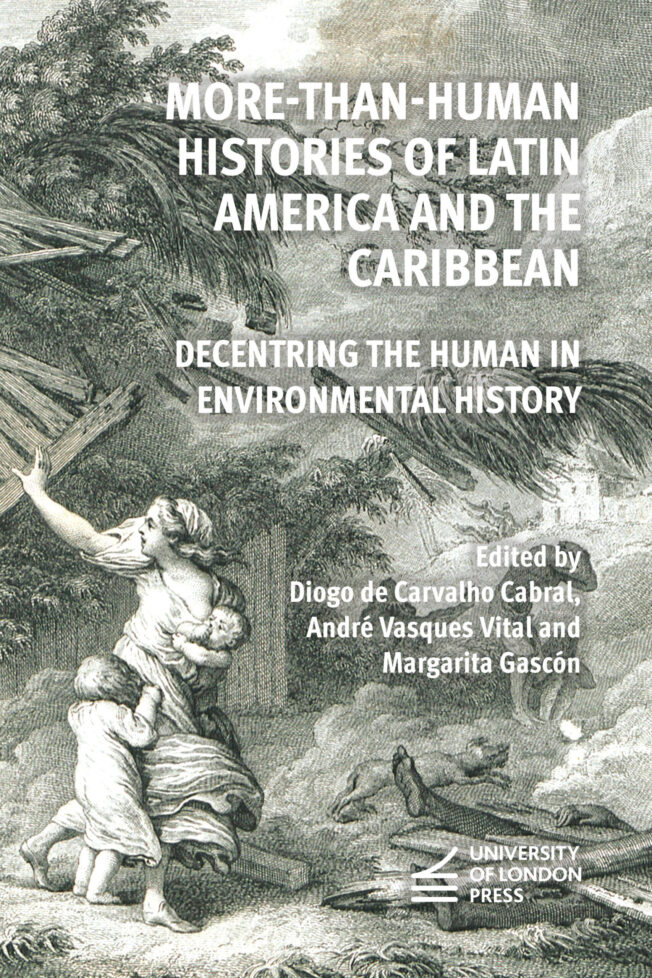

More-Than-Human Histories of Latin America and the Caribbean
Decentring the Human in Environmental History
Diogo de Carvalho Cabral (Editor), André Vasques Vital (Editor), Margarita Gascón (Editor)

Published in association with: Centre for Latin American and Caribbean Studies
The Latin American and Caribbean regions’ historical trajectories have been shaped by complex human-nonhuman interactions. In these histories people are important, even crucial, actors, but not the only ones. Offering a novel approach to the writing of Latin American history, this book brings nine thought-provoking chapters together with a historiographical introduction and critical afterword to centre nonhuman beings and things. The oscillating glare of the sun, the resourcefulness of insects, the tectonic instability of national territories, and the life-giving and intractable impassivity of rivers are some of the other-than-human agents driving history in the volume’s chapters. It problematises Latin American(ist) historiography’s tendency to frame ‘nature’ as a separate ontological domain that is only acted upon – conquered, manipulated, devastated – lacking the self-propelled dynamics capable of shaping the course of events. With broad regional and temporal coverage across Latin America and the Caribbean from the pre-colonial period to the present day, the book responds to environmental history’s call to write biophysical environments into the human past – a reconsideration of historical agency that, in this era of climate change, is needed now more than ever.
‘More-Than-Human Histories of Latin America and the Caribbean offers a rich and complex study of environmental history that breaks new ground in moving from human-centered approaches and methods to take seriously other biological, geographical and even solar processes that together shape human history in Latin America. The interdisciplinary scope of the studies is impressive, along with the types of sources used, geographies and timescales.’
— Martha Few, Liberal Arts Professor of Latin American History and Women’s, Gender, and Sexuality Studies, Penn State University, USA
More-Than-Human Histories of Latin America and the Caribbean is more than a thematically coherent collection of scholarly essays by multiple authors. By respectfully engaging Indigenous perspectives, based on long-standing interactions with nature, this work is both Neo-Animist and Transhumanist in its approach. …the authors have us embrace both ancient Indigenous traditions and the vision of a better future.’
—Abel A. Alves, Ball State University, Muncie, USA
Journal of Latin American Geography
…the book will be a welcome starting point for many scholars of the environmental humanities in Latin America. Moreover, the book succeeds in showing historians outside the field of environmental history how more-than-human histories can be of value in more human-centered studies.
— Christopher McQuilkin, University of California, Santa Barbara, USA
Humanities and Social Science Online
This volume offers a useful primer on the emerging approaches to the study of history.
— Ed Stoddard, Freelance Journalist/Editor/Consultant, Johannesburg, South Africa
The Daily Maverick
-
Introduction: Latin America and the Caribbean’s more-than-human pasts
Diogo de Carvalho Cabral, André Vasques Vital, and Margarita Gascón -
1 Performative objects: Konduri iconography as a window into precolonial Amazonian ontologies
Luisa Vidal de Oliveira and Denise Maria Cavalcante Gomes -
2 Under a weak sun at the Southern rim of South America (1540-1650)
Margarita Gascón -
3 Extreme weather in New Spain and Guatemala: the Great Drought (1768-1773)
Luis Alberto Arrioja Díaz Viruell and María Dolores Ramírez Vega -
4 Water labour: urban metabolism, energy, and rivers in nineteenth-century Rio de Janeiro, Brazil
Bruno Capilé and Lise Fernanda Sedrez -
5 ‘Forjadores de la nación’: rethinking the role of earthquakes in Chilean history
Magdalena Gil -
6 Human-insect relations in Northeast Brazil’s twentieth-century sugar industry
José Marcelo Marques Ferreira Filho -
7 “We are the air, the land, the pampas…”: campesino politics and the other-than-human in highland Bolivia 1970-1990
Olivia Arigho-Stiles -
8 Tongues in trees and sermons in stones: Jason Allen-Paisant’s Ecopoetics in Thinking with Trees
Hannah Regis -
9 Animating the waters, hydrating History: control and contingency in Latin American animations
André Vasques Vital -
Afterword: More complete stories and better explanations for a renewed worldview
Claudia Leal
PDF: 9781915249524
Read Online: 9781915249692
Hardback: 9781915249500 / 308 pages / 240mm x 160mm
Paperback: 9781915249517 / 308 pages / 234mm x 156mm
Diogo de Carvalho Cabral (Editor) 
Diogo de Carvalho Cabral is an Assistant Professor in Environmental History and a member of the Trinity Centre for Environmental Humanities (TCEH) at Trinity College Dublin (Ireland). Before that, he was a British Academy-funded Newton International Fellow based at the Institute of Latin American Studies/School of Advanced Study, University of London (United Kingdom). His academic awards include the Journal of Historical Geography Best Paper Prize (2016) and an honourable mention in the Milton Santos Prize (2017). He is the author of Na Presença da Floresta: Mata Atlântica e História Colonial (Rio de Janeiro, 2014) and co-edited Metamorfoses Florestais: Culturas, Ecologias e as Transformações Históricas da Mata Atlântica (Curitiba, 2016) with Ana Bustamante. Sitting at the interface between History, Geography, Ecology, and Anthropology, his work addresses the historical dimensions of multispecies environmental change in modern Brazil.
André Vasques Vital (Editor)
André Vasques Vital is an Associate Professor in Environmental Sciences at the Evangelical University of Goiás -UniEVANGELICA, Brazil. He is co-editor of Águas no Brasil: Conflitos, Atores, e Práticas (Editora Alameda, 2019) and has published articles in important international journals such as Feminist Media Studies and ISLE: Interdisciplinary Studies in Literature and Environment. He also co-edited the special issue Tropical Imaginaries and Climate Crisis: Embracing Relational Climate Discourses (eTropic, 2021). His works propose a non-humanist historical perspective, mainly through fantasy and science fiction animations, where waters and non-human animals are understood as active agents in the constitution of the past.
Margarita Gascón (Editor)
Margarita Gascón earned her master's and Ph.D. from the University of Ottawa, Canada. She is a tenured researcher of the National Council for Scientific and Technological Research (CONICET) in Argentina and also teaches at undergraduate and graduate levels in Mendoza. Among her most recent publications are the Afterword to De viejas y nuevas fronteras en América y Europa, edited by Macarena Sánchez Pérez and Katherine Quinteros Rivera (Editorial Universidad Finis Terrae, 2022) and chapters in Critica de la Razón Indígena, edited by Carlos Felimer del Valle Rojas and Alejandra Cebrelli (Editorial Universidad Nacional de La Plata, 2023), and the 'Land Use' and 'Climatic Change' Handbooks: The Anthropocene as multiple crisis. Perspectives from Latin America (CALAS, 2023–2024).
‘More-Than-Human Histories of Latin America and the Caribbean offers a rich and complex study of environmental history that breaks new ground in moving from human-centered approaches and methods to take seriously other biological, geographical and even solar processes that together shape human history in Latin America. The interdisciplinary scope of the studies is impressive, along with the types of sources used, geographies and timescales.’
— Martha Few, Liberal Arts Professor of Latin American History and Women’s, Gender, and Sexuality Studies, Penn State University, USA
More-Than-Human Histories of Latin America and the Caribbean is more than a thematically coherent collection of scholarly essays by multiple authors. By respectfully engaging Indigenous perspectives, based on long-standing interactions with nature, this work is both Neo-Animist and Transhumanist in its approach. …the authors have us embrace both ancient Indigenous traditions and the vision of a better future.’
—Abel A. Alves, Ball State University, Muncie, USA
Journal of Latin American Geography
…the book will be a welcome starting point for many scholars of the environmental humanities in Latin America. Moreover, the book succeeds in showing historians outside the field of environmental history how more-than-human histories can be of value in more human-centered studies.
— Christopher McQuilkin, University of California, Santa Barbara, USA
Humanities and Social Science Online
This volume offers a useful primer on the emerging approaches to the study of history.
— Ed Stoddard, Freelance Journalist/Editor/Consultant, Johannesburg, South Africa
The Daily Maverick
Subject: Environmental Humanities, Languages, Cultures and Societies, Latin American and Caribbean Studies
BISAC codes: HIS052000, NAT010000, SCI100000
Thema codes: NHAH, NHK, RNA
Keywords: Caribbean, biophysical, climate change, ecology, environmental humanities, historiography, history, latin america, non-human, south america
More books in this subject area
Artificial Intelligence, Art and Indigeneity
Thea Pitman
Sandra De Berduccy
Andreas Rauh
17 September 2026

Postcards, Translators and Esperanto Pioneers
Guilherme Fians
Bernhard Struck
Claire Taylor
13 November 2025
Liberation Theology and Praxis in Contemporary Latin America
Pablo Bradbury
Niall H.D. Geraghty
20 February 2025

The Social and Political Life of Latin American Infrastructures
Jonathan Alderman
Geoff Goodwin
5 October 2022

Opposing Patriarchy: Women and the Law in Action in Pre-Unification Italy (1815-1865)
Sara Delmedico
15 November 2021