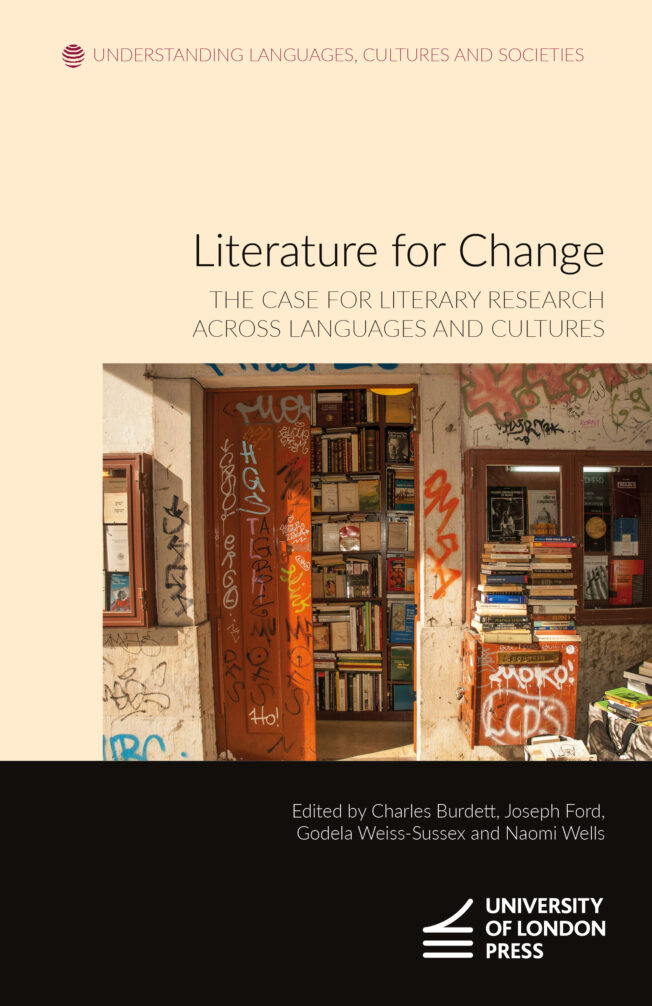

Literature for Change
The Case for Literary Research Across Languages and Cultures
Charles Burdett (Editor), Joseph Ford (Editor), Godela Weiss-Sussex (Editor), Naomi Wells (Editor)

Series: Understanding Languages, Cultures and Societies
Published in association with: Institute of Languages, Cultures and Societies
Open Access publication funded by American Council of Learned Societies with generous support from Arcadia
Literature for Change is a timely and thought-provoking intervention that tackles the critical question of how the study of literary texts in languages other than English, and their production, circulation and reception, contributes to efforts to address today’s most pressing social challenges. Featuring ten case studies across diverse languages and cultures, the book explores the transformative real-world impact that literary research has made on society. Taking hermeneutic and aesthetic approaches, the case studies illustrate the contribution of literary studies to areas as disparate as the museums and heritage sector, the environmental and medical humanities and the digital world. The volume advocates for a plurality of approaches, including creative enquiry with a solid theoretical grounding, and of the connectivity of literary research with disciplines beyond Modern Languages and beyond the academy.
At a time when the field of Modern Languages is going through significant transformation, Literature for Change makes a compelling case for the value of the discipline, and reaffirms the relevance of literary texts and the power of stories to shape social, cultural and intellectual life.
This compelling volume shows why literature matters, why literature in other languages matters, and—above all—why research into literature in other languages matters. Ten case studies, from Arabic to German, from medieval to contemporary, reveal the multilayered, multilingual power of literature to change lives and societies—including in the troubled present.
—Neil Kenny, Professor of French and Senior Research Fellow, University of Oxford, UK
Literature for Change is an ambitious, important and timely intervention which makes a compelling case for the ways in which studying literature through a foreign language develops citizens able to navigate the unprecedented challenges of climate change, increasingly isolationist governance, global capitalism and artificial intelligence. A seminal text.
—Elizabeth Wren-Owens, Reader in Italian and Translation Studies, University of Cardiff, UK
Literature for Change dives headlong into the gaping holes of contemporary cultural crises, and bounces back as an impassioned series of manifestoes bridging art and life. The thoughtful sequence of essays democratizes literature’s transformative qualities. Running the gamut from major to minor and even ultra-minor modes of writing, the book’s worldliness induces readers into the uncharted waters of an intellectual trance. Literature unlocks multitudes of empathy, carrying us through and across languages, nations, and genres that are ever expansive and mind-altering.
—Yasser Elhariry, Associate Professor, Dartmouth College, USA
-
Introduction: Making the Case for Literary Research Across Languages and Cultures
Charles Burdett, Joseph Ford, Godela Weiss-Sussex and Naomi Wells -
1 Modern medieval languages: reading in and out of time
Sarah Bowden -
2 Literary Research After the Decolonial Turn: Towards New Praxis
Emanuelle Santos -
3 The Geopolitics of Literary Studies in a Time of Crisis Reham Hosny
-
4 Place and planet: literary research in an age of ‘global challenges’
Nicola Thomas -
5 Translating the Past: Literary Research, Public History and the Heritage of Wales
Carol Tully -
6 Towards sustainable practices in the ‘post-museum’? post-object lessons from contemporary world literature
Emma Bond -
7 What Literature Can Do for Health: A Spotlight on Eating Disorders in Men and Boys
Heike Bartel -
8 Reality, representation, resistance: a case study of an Arab cancer ethnodrama
Abir Hamdar -
9 Kalila wa Dimna and The Arts of Storytelling: Conversations with Medieval Arabic Literature in Contemporary London
Rachel Scott -
10 Fox Tales, Community Concerns: Why Collaborative Storytelling Matters
Anja Rekeszus
PDF: 9781911507819
EPUB: 9781911507826
Read Online: 9781911507802
Hardback: 9781911507789 / 238 pages / 220mm x 144mm
Paperback: 9781911507796 / 238 pages / 216mm x 140mm
Charles Burdett (Editor) 
Charles Burdett is Professor of Italian and Director of the Institute of Languages, Cultures and Societies (School of Advanced Study, University of London). The principal areas of his research are literary culture under Fascism; travel writing; the Italian colonial presence in Libya and East Africa and its legacies; theories of inter-cultural contact; the representation of Islam and the Islamic world in recent Italian literature and culture. He was the Principal Investigator of the AHRC large grant, ‘Transnationalizing Modern Languages: Mobility, Identity, and Translation in Modern Italian Cultures’ (2014-18). He is currently completing an AHRC impact and engagement fellowship, ‘Uncovering the Afterlife of the Italian Empire’.
Joseph Ford (Editor)
Joseph Ford is a Senior Lecturer in French Studies at the Institute of Languages, Cultures and Societies (ILCS), based in the University of London’s School of Advanced Study, where he specialises in contemporary French and Francophone Literature and Culture, with specific interests in North Africa. He has written on theories and discourses of world and comparative literature in relation to the wider Francosphere, on memory and responsibility in Europe, and on multilingualism and education in the UK. Together with Emanuelle Santos, he is the co-convenor of the Decolonising Languages Network.
Godela Weiss-Sussex (Editor)
Godela Weiss-Sussex is Professor of Modern German Literature at the Institute of Languages, Cultures and Societies at the School of Advanced Study, University of London, and Co-Director of the Centre for the Study of Contemporary Women’s Writing. Her main research interests lie in the culture and literature of the twentieth and twenty-first centuries in the following areas: women’s writing, the works of German-Jewish writers produced in Germany and in exile; multi- and translingualism; postmigrant imaginaries of belonging.
Naomi Wells (Editor)
Naomi Wells is a Senior Lecturer in Italian and Spanish with Digital Humanities at the Institute of Languages, Cultures and Societies and the Digital Humanities Research Hub at the School of Advanced Study, University of London. Her recent research focuses on multilingualism on the internet and social media, and sits at the intersection of digital humanities, sociolinguistics, migration studies, and translation and cultural studies. She has a wider interest in supporting cross-languages digital research in her role as joint editor of the Digital Modern Languages section of the Modern Languages Open journal.
This compelling volume shows why literature matters, why literature in other languages matters, and—above all—why research into literature in other languages matters. Ten case studies, from Arabic to German, from medieval to contemporary, reveal the multilayered, multilingual power of literature to change lives and societies—including in the troubled present.
—Neil Kenny, Professor of French and Senior Research Fellow, University of Oxford, UK
Literature for Change is an ambitious, important and timely intervention which makes a compelling case for the ways in which studying literature through a foreign language develops citizens able to navigate the unprecedented challenges of climate change, increasingly isolationist governance, global capitalism and artificial intelligence. A seminal text.
—Elizabeth Wren-Owens, Reader in Italian and Translation Studies, University of Cardiff, UK
Literature for Change dives headlong into the gaping holes of contemporary cultural crises, and bounces back as an impassioned series of manifestoes bridging art and life. The thoughtful sequence of essays democratizes literature’s transformative qualities. Running the gamut from major to minor and even ultra-minor modes of writing, the book’s worldliness induces readers into the uncharted waters of an intellectual trance. Literature unlocks multitudes of empathy, carrying us through and across languages, nations, and genres that are ever expansive and mind-altering.
—Yasser Elhariry, Associate Professor, Dartmouth College, USA
Subject: Humanities Advocacy, Languages, Cultures and Societies, Literary Studies
BISAC codes: LIT006000, LIT024060, SOC008000
Thema codes: DSA, DSBJ, JB
Keywords: Multiculturalism, activism, culture, equality, humanities research, literary studies, society, world literature
EPUB accessibility:
Accessibility summary
EPUB Accessibility Specification 1.1
Table of contents navigation
Index navigation
Single logical reading order
Short alternative textual descriptions
Print-equivalent page numbering
Use of color is not sole means of conveying information
Next / Previous structural navigation
ARIA roles provided
Appearance of all textual content can be modified
All non-decorative content supports reading without sight
WCAG v2.2
WCAG level AA
Compliance certification by (name)
More books in this subject area
Artificial Intelligence, Art and Indigeneity
Thea Pitman
Sandra De Berduccy
Andreas Rauh
17 September 2026

Postcards, Translators and Esperanto Pioneers
Guilherme Fians
Bernhard Struck
Claire Taylor
13 November 2025
Liberation Theology and Praxis in Contemporary Latin America
Pablo Bradbury
Niall H.D. Geraghty
20 February 2025
More-Than-Human Histories of Latin America and the Caribbean
Diogo de Carvalho Cabral
André Vasques Vital
Margarita Gascón
25 July 2024
The Social and Political Life of Latin American Infrastructures
Jonathan Alderman
Geoff Goodwin
5 October 2022